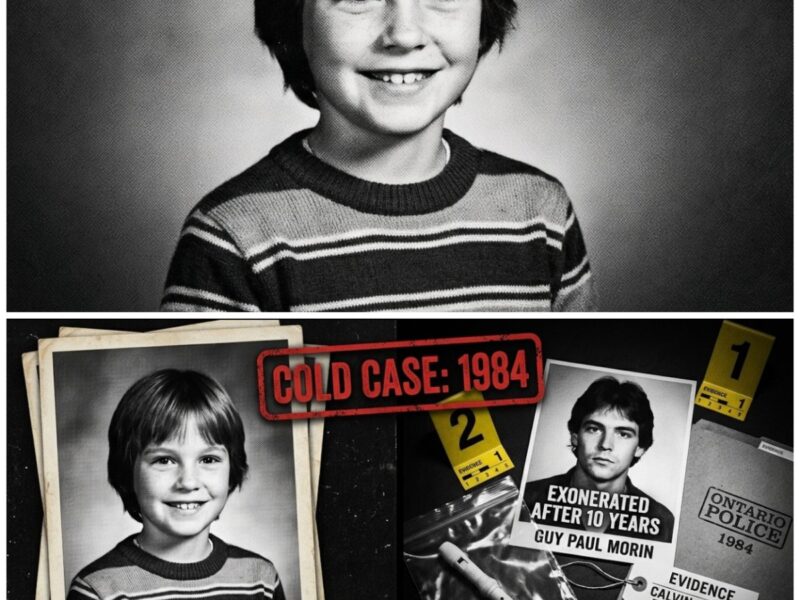
He Stood at Her Grave for 10 Years: The Cold Case of Christine Jessop
On the last day of 1984, a man named Fred Patterson was walking through a wooded area near the village of Sunderland, Ontario, looking for his dog.
Instead, he found a child.
She had been missing for 90 days.
Her name was Christine Jessup, and she was 9 years old.
For 3 months, police and volunteers had searched for her across the farm country north of Toronto.
Her face had been on posters and on the evening news.
She had been found about 56 km from her home.
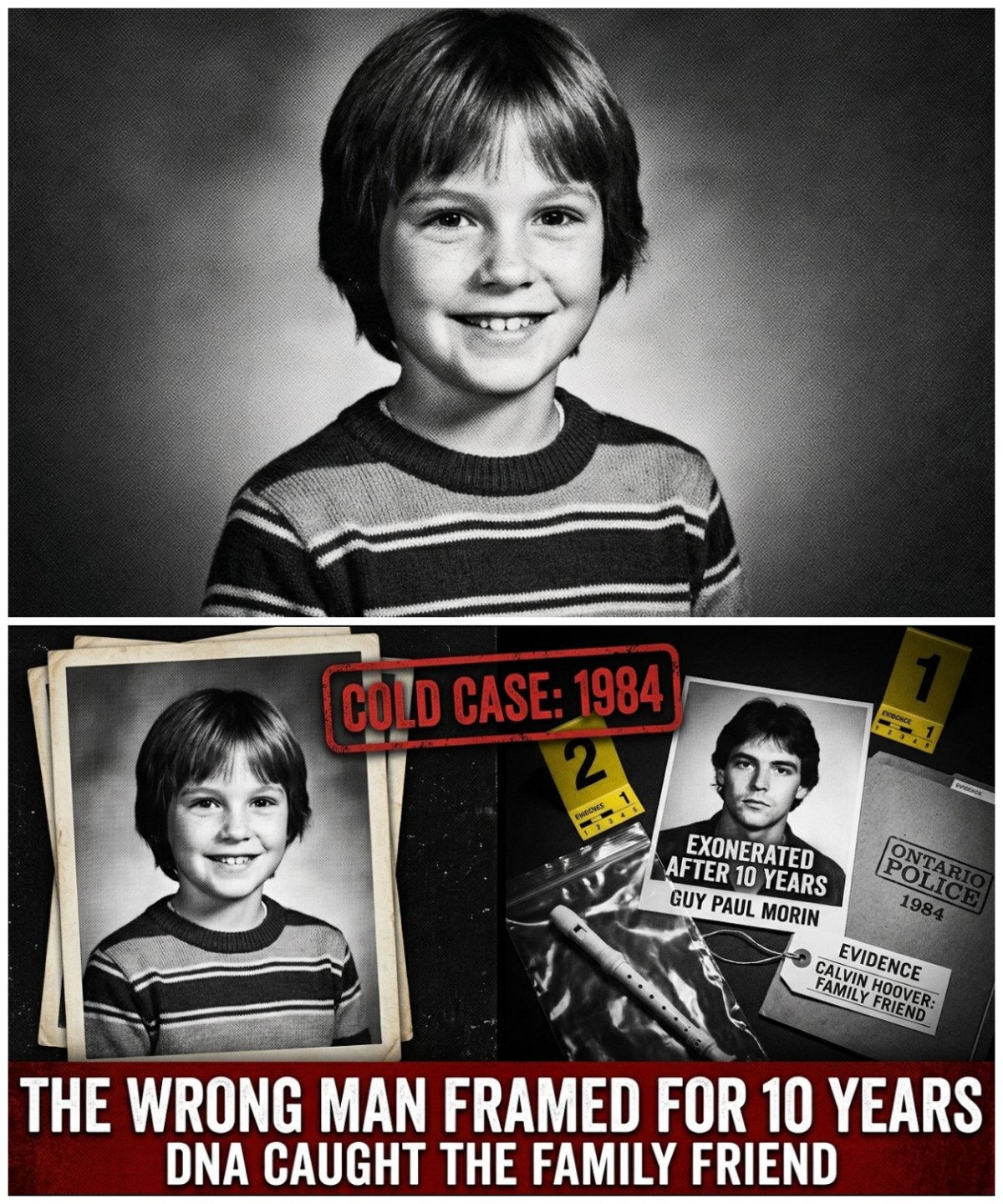
Near her lay a small recorder, the kind children play in music class, with her name written on it.
The search for Christine Jessup was over.
The search for her killer was only beginning.
And it would become one of the most infamous criminal cases in Canadian history.
The police would focus on the young man who lived next door.
He was a quiet young man from a hardworking family, a musician who played the clarinet.
He would be arrested, tried, acquitted, tried again, and convicted of first-degree murder.
He would be sentenced to life in prison, and then DNA would prove that he was innocent.
For 25 more years after that, Christine’s killer had no name.
The man who had actually taken her had never been interviewed by police at all, even though his name had been written down in a detective’s notebook within days of her disappearance.
He had been at the searches.
He had been at her funeral.
He had comforted his wife when she wept at Christine’s grave.
This is the story of Christine Jessup, the girl who went to buy a pack of gum and never came home.
It is the story of Guy Paul Moren, the neighbor who was convicted of a crime he did not commit, and of the inquiry that changed how murder cases are investigated across Canada.
And it is the story of how 36 years later, a detective who had been a boy when Christine vanished finally found the man responsible through the family trees of strangers.
Stay with me because when the name finally came, it came from inside the Jessups’ own circle of friends.
And if you are new here, subscribe to the cold record.
We go back into the files that were left unfinished and we follow them as far as the evidence goes.
To understand who was lost, you have to begin in Queensville.
In 1984, Queensville was a small rural hamlet in York Region, about 50 km north of Toronto, just west of Highway 404 in the town of East Gilmbberry.
It was the kind of place where children rode their bikes to the corner store, where the school bus dropped kids off at the end of the road, and where most people knew their neighbors.
Christine Marian Jessup lived there with her mother Janet and her older brother Kenny who was 5 years older.
She was nine.
By every account, she was a lively, independent, imaginative girl.
She loved baseball and riding her red bicycle.
She loved animals.
Her beagle, Freckles, followed her everywhere.
She had a pet frog named Harold.
Her mother would later describe her as tomboyish and gentle at the same time.
Kenny remembered how she followed him everywhere, the way little sisters follow big brothers.
The Jessup family was going through a hard time.
Christine’s father, Bob Jessup, was in jail.
He was serving an 18-month sentence at the Toronto East detention center for defrauding elderly family friends.
Janet was holding the household together on her own.
Janet was a protective mother.
She usually knew exactly where her children were.
The Jessups had friends from Bob’s work.
Bob had worked at a company in Markham called Eastern Independent Telecom.
Among his co-workers were a married couple, Heather and Calvin Hoover.
Heather worked there as a dispatcher.
Calvin was a cable installer.
He was 28 years old.
The two families had become close.
Janet and Heather hit it off.
The families got together for barbecues.
The Hoover’s sons played with Christine and Kenny.
And Christine loved the Hoover’s youngest boy, who was still a toddler.
Sometimes Heather babysat Christine.
Christine called her auntie Heather.
On Monday, October 1, 1984, Janet took the children to visit the Hoovers.
During the visit, she mentioned her plans for that Wednesday.
She and Kenny were going to visit Bob in jail.
Christine would not be coming.
She would be getting off the school bus and staying home.
Years later, Kenny would remember that there had been only a few people his mother told about that day.
One of them was Heather Hoover.
Wednesday, October 3rd, 1984 was an ordinary school day.
In music class, Christine had been given a new recorder.
She took it home on the bus.
When she got home, her mother and brother were not there yet.
She dropped off her school bag.
Christine found a nickel and she walked to the corner store where she bought a pack of gum.
She had made plans to meet a friend, a girl named Leslie Chipman, at a park across from the store at around 4:00.
Janet had given her daughter clear rules for afternoons like this one.
If no one was home, Christine was not supposed to leave the house.
She was supposed to stay inside with freckles until her mother got back, but Christine was nine and independent and the corner store and the park were just a short walk away.
Leslie went to the park and waited.
Christine never came.
After a while, Leslie went home.
Janet and Kenny got home at about 4:10.
Christine was not there.
Her red bicycle was lying on its side in the shed with its kickstand damaged.
Her jacket was hanging on a hook in the house, a hook that was higher than Christine could reach.
Janet went looking.
She checked the nearby cemetery and the playground and walked the neighborhood.
Around 5:00, she started phoning Christine’s friends.
No one had seen her.
After the sun went down, Janet called the police.
The case went to the York Regional Police in 1984.
It was a small force.
It had no major crimes unit and little experience with child abductions.
The first days of the investigation would later be heavily criticized.
A constable took Christine’s jacket down from the hook.
Newspaper wrapping found in the house was thrown away without being checked for fingerprints.
Neighbors came and went through the Jessup home freely.
Volunteers poured into Queensville.
A command post was set up at the local fireh hall.
Search parties combed fields, woods, and ditches.
They found no trace of Christine.
The police asked the Jessups for a list of people who had been allowed into their home when the family was not there.
One of the names Janet gave them was Calvin Hoover.
The day after Christine disappeared, a York Regional Police Sergeant named Raymond Bunts went to see Heather Hoover.
He asked her she would later say every question possible.
She told him her husband had been at work that afternoon.
The sergeant wrote the Hoover’s name and address in his notebook.
No one ever interviewed Calvin Hoover.
Calvin came to Queensville and helped with the searches.
He was there with everyone else looking for the little girl who called his wife Auntie Heather.
The days became weeks.
Bob Jessup was released from jail on humanitarian grounds so he could be with his family during the search.
Posters went up across York Region and beyond.
Tips came in.
None of them brought Christine home.
October became November.
November became December.
Christine had been gone for 3 months.
And then on December 31st, 1984, Fred Patterson went looking for his dog.
The wooded area where Christine was found was near Sunderland in Durham region east of Queensville.
Investigators determined that she had been sexually assaulted and stabbed to death.
The recorder from her music class lay nearby.
For Janet, Kenny, and Bob, 90 days of hope ended in a single afternoon.
Christine was laid to rest in January 1985.
Her brother would later remember who came to the funeral and to the wake.
One of them was Calvin Hoover.
Because Christine’s body had been found in Durham Region, the murder investigation was taken over by the Durham Regional Police.
Inspector Robert Brown oversaw it.
Two detectives, Bernie Fitzpatrick and John Shepard, did much of the work.
The York police had collected notes and names during the missing person’s search, including Calvin Hoover’s name and address.
But in the shift from one police force to another, from a missing child search to a homicide, the early material was largely set aside.
Calvin Hoover was never looked at.
Instead, the detectives began looking for a suspect among the people close to home.
On February 14th, 1985, they asked the Jessups whether there was anyone they thought might be capable of the crime.
Janet named their next door neighbor, Guy Paul Morren.
Morren was 25 years old.
He lived with his parents in the house next door.
The Morren were a large, hard-working family.
His father, Alons, was a retired engineer and an army veteran.
His mother, Ida, was a trained nurse.
They had six children.
Guy Paul worked at a furniture factory.
In his free time, he played the clarinet in a band.
He had not joined the search for Christine.
Some saw that as strange.
In his notes, Detective Fitzpatrick wrote a short description of him.
Clarinet player, weird type guy.
Morren had an alibi.
He had punched out at the furniture factory at Steels Avenue and Weston Road in Toronto at 3:32 that afternoon.
Police calculated that driving home he could not have arrived in Queensville before about 4:14.
Janet and Kenny had come home at 410 and Christine was already gone.
On its face, the timeline cleared him, but the detectives were convinced.
In an interview, Morren made remarks that police treated as evidence.
He described Christine as sweet and innocent, and he said something about how girls sometimes grow up to be corrupt.
To the detectives, it sounded like a motive.
Then came the forensic evidence.
Investigators had recovered a single dark hair caught in Christine’s necklace.
It was badly degraded.
To compare it with Morren’s hair, police used an undercover ploy.
An officer collected samples of Morin’s hair at a band practice under the pretext of a cosmetics class project.
At the Center of Forensic Sciences, Ontario’s government forensic lab, a scientist named Stephanie Nisnik, compared the hairs.
She described them as similar and said Morren’s hair was consistent with the hair from the necklace.
Years later, she would say she had only meant that it could have come from him, and she would admit that she might have overstated her conclusions.
An FBI profiler produced a profile and sketch of the kind of person who might have committed the crime.
When the police released it to the public, they left out parts that did not fit Morin.
And there was the timeline.
After detectives suggested that the clock in her house might have been slow, Janet Jessup revised her memory of when she had come home that day.
Instead of 4:10, she now said it might have been around 4:20 or even as late as 4:35.
That change opened a window of time for Morren to have reached Queensville.
On April 22nd, 1985, police arrested Guy Paul Morren on his way to ban practice.
He was charged with first-degree murder.
When the officers told him why, he answered with four words.
What?
You’re joking.
He was not joking, and neither were they.
Morren’s first trial began in early 1986.
His lawyer was Clayton Ruby, one of the best known defense lawyers in Toronto.
The case against Morin had serious problems, and Ruby exposed many of them.
A cigarette butt found at the scene went missing after police learned that Morin did not smoke.
Red fibers that the crown said linked Morren to Christine were questioned and the police brought in an undercover officer who had been placed in Morren’s jail cell.
The officer, Gordon Hobbs, claimed Morren had confessed to him.
As evidence, Hobbs said Morren had talked about how he would redrum the innocent, the word murder spelled backward.
Morren said he had been referring to the horror film The Shining, in which the word appears.
The way the police handled their own records would later become part of the scandal, too.
One of the officers involved in the case was eventually charged with perjury and obstructing justice.
Accused of keeping a second notebook.
It was one more sign of an investigation that had gone badly off course.
The jury deliberated for one day.
In 1986, it found Guy Paul Moran not guilty.
Kenny Jessup wept in the courtroom.
Bob Jessup spoke to reporters.
We’ve lived a year and a half of hell, he said, and now the hell goes on.
For the Jessups, the aqu quiddle did not feel like justice.
They believed the police had the right man and that he had walked free.
For the Morren, the aqu quiddle did not bring peace either.
After the verdict, the family received threats and menacing notes.
Someone threw a beer bottle through a window of their house.
To many people in the community, Guy Paul Morren was still the man who had killed Christine Jessup, whatever a jury said, and the crown was not finished with him.
Ontario’s prosecutors appealed the acquitt.
In 1987, the Ontario Court of Appeal ruled that the trial judge had made errors in his instructions to the jury about reasonable doubt and it ordered a new trial.
Morren appealed that decision to the Supreme Court of Canada.
In November 1988, the Supreme Court dismissed his appeal.
He would have to stand trial again.
The second trial did not begin until 1990, and it dragged on for many months.
By then, much of the original evidence had gone missing, including two of Christine’s bones and many of Stephanie Nisnik’s notes.
In July 1992, more than 7 years after his arrest, the jury reached its verdict.
Guy Paul Morren was guilty of first-degree murder.
He was 32 years old.
He was sentenced to life in prison.
“I am not guilty of this crime,” Morren said.
The Jessups had believed for almost 8 years that the man next door had killed Christine.
Now, a jury agreed with them.
For Morren, it was the beginning of a nightmare.
He went to prison as a convicted child killer, one of the most dangerous labels a man can carry behind bars.
According to a later account, he was protected inside by a feared inmate who believed he was innocent.
Outside the prison walls, not everyone believed the verdict.
A group of supporters had formed around Guy Paul Morin.
Convinced that he was innocent, they organized, raised money, and lobbied for him.
In 1993, a poll found that 53% of people in Ontario thought Morren should be released on bail while he appealed.
On February 9th, 1993, he was granted bail.
His new lawyers, James Locker and Joanne Mlan, prepared his appeal.
It was expensive.
The legal costs reached roughly half a million dollars.
To help pay them, his parents mortgaged their home, and Morren’s lawyers wanted one more thing.
They wanted the evidence tested with a new kind of science.
In 1984, DNA profiling did not exist in Canadian criminal courts.
By the early 1990s, it was beginning to change investigations across North America.
Christine’s underwear had been preserved, and it contained semen left by her attacker.
If the seaman could be tested, it could answer the question once and for all.
The testing was done before the appeal was heard.
The result was clear.
The seaman on Christine Jessup’s underwear did not come from Guy Paul Morin.
On January 23rd, 1995, the Ontario Court of Appeals set aside his conviction and entered an acquitt.
The charges were dropped and his record was cleared.
Guy Paul Morren became the first person in Canada to be exonerated by DNA evidence.
He had been arrested at the age of 25.
He was now 35.
He had spent 10 years accused of murdering a 9-year-old girl, including many months behind bars, two trials, a conviction for first-degree murder, and a life sentence.
His family had nearly lost everything defending him, and through all of it, he had been telling the truth.
Morren would later say that from that moment, he believed the same science would eventually name the real killer.
For the Jessups, the exoneration was a second loss.
For more than 10 years, they had believed they knew who killed Christine.
Now they were told that the man next door, the man they had named, the man two juries had judged, had nothing to do with it.
Whoever had taken Christine was still out there, and the trail was more than a decade cold.
The Ontario government ordered a public inquiry into what had gone wrong.
On June 26th, 1996, the province appointed Fred Kaufman, a former judge of the Quebec Court of Appeal to lead the commission on proceedings involving Guy Paul Moran.
The hearings began on February 10th, 1997.
They ran for 146 days.
The commission heard from 120 witnesses, reviewed more than 100,000 pages of documents, and granted standing to 25 different parties.
Kaufman delivered an oral ruling on October 22nd, 1997.
As the hearings came to a close on April 9th, 1998, he released his full report.
It filled two volumes and 1,380 pages, and it made 119 recommendations.
Kaufman did not find that any police officer or prosecutor had set out to convict an innocent man.
What he found was something he described as tunnel vision.
Investigators had become fixed on one suspect early and from then on they interpreted everything through that lens.
Evidence that fit Morren was treated as proof.
Evidence that did not fit was explained away, overlooked or set aside.
The inquiry also looked hard at the jailhouse evidence.
In Morren’s case, the claimed confession had come from an undercover officer placed in his cell, and jailhouse witnesses would also testify against him.
Kaufman warned that evidence from jailhouse informants, people with their own reasons to tell the authorities what they wanted to hear, was among the most dangerous evidence a court could receive.
He recommended that prosecutors adopt strict rules before ever putting such a witness on the stand.
The forensic evidence had been misused.
Hair and fiber comparisons from the provincial forensic lab had been presented in ways that made them sound far more meaningful than they were.
Kaufman summed up the strange shape of the case in a single idea.
Science had helped to convict Morin and science had set him free.
The report made recommendations across the whole system.
Forensic scientists should explain the limits of their evidence to juries.
Evidence should be kept so it could be retested.
Prosecutors should treat jailhouse informants with extreme caution.
Police should record interviews with suspects on video or audio.
Alibis should be checked by officers other than the ones building the case.
Police and prosecutors should be trained to recognize tunnel vision.
And when a missing person case became a homicide, the evidence from the early search should be preserved.
The Kaufman report became one of the most important documents in the history of Canadian criminal justice.
Bruce McFarland, a lawyer and legal scholar, later described it as arguably the most comprehensive review of the causes and prevention of wrongful convictions ever undertaken.
It changed how murder investigations are run in Canada.
The group that had formed to support Morin went on to help others.
It became the association in defense of the wrongly convicted and later Innocence Canada, which works to free people convicted of crimes they did not commit.
In 1997, the province of Ontario paid Morren a settlement of about $1.2 million.
A large part of it was set aside for his parents, who had mortgaged their home to pay for his defense.
Morren tried to rebuild his life.
He married and had children.
He worked at Toronto’s Pearson Airport handling baggage and later became a piano technician.
But the suspicion never fully went away.
According to one account, when he tried to enroll his son in a school near Barry, the school refused after parents learned who he was.
Many people still whispered that he had done it.
The detectives from the original investigation went on with their lives, too.
Bernie Fitzpatrick retired from the police in 1993 and later drove a school bus.
Years afterward, he still had not apologized to the Morren family.
In his view, the detectives had only gathered the evidence.
The cops pick up the rocks.
He said it’s the crown attorneys who break the windows.
Neither he nor his partner, John Shepard, had known anything about Calvin Hoover.
Guy Paul Morren’s father, Alonses, died in the years that followed.
His mother, Ida, the nurse who had stood by her son through two trials, was still living in the family home in Queensville at the age of 99 when Calvin Hoover was identified.
If you have stayed with Christine’s story this far and you want to see how a detective who was 13 years old when she disappeared finally found the man who took her and how the answer came from the Jessup’s own circle of friends.
This is a good moment to subscribe to the cold record because the next part of this story is about the 25 years that followed and the man who was there the whole time.
After Morren’s exoneration, the case of Christine Jessup went cold again.
There was still DNA from the seaman on Christine’s underwear.
Investigators could compare it to suspects.
They could run it against the National DNA datab bank once Canada created one, but the profile never matched anyone.
Whoever left it had apparently never been convicted of a crime serious enough to put his DNA in the system.
Canada’s national DNA datab bank did not open until 2000.
Even then, it held profiles only from people convicted of certain designated offenses along with DNA from crime scenes.
Calvin Hoover’s one known conviction in those years for drunk driving was not the kind of offense that required a DNA sample.
As far as the national system was concerned, he was invisible.
Years passed.
Janet Jessup never stopped looking.
She would go on to spend decades volunteering, helping the families of missing children, and supporting families at crime scenes.
Her son Kenny grew up and built a life, but the case never left him.
In 2016, 32 years past the worst day of her life, Janet told a reporter that she was still searching for her daughter’s killer and her questions had not changed.
I want to find him, she said.
That’s my goal.
Where is the person that did it?
She did the arithmetic out loud.
Christine, she said, would be 41 or 42 now.
Where is he?
And the second question, she said, was why?
She remembered the moment she learned Christine was dead.
As soon as we saw our minister and police walk up the driveway, she said, “We knew.
You can’t fathom it.” She said, “You can’t unless you’ve gone through it.” By then, the case belonged to the Toronto Police Service, which had taken it over after Morren was cleared.
A detective sergeant in the homicide unit, Stacy Galant, told reporters that Christine had most likely been taken by vehicle to Durham Region.
No one wants to see a young child taken and murdered, he said, and not found for an extended period of time.
Meanwhile, Calvin Hoover went on with his life.
He and Heather stayed married for years after Christine’s death.
Heather visited Christine’s grave regularly for about a decade.
Calvin went with her.
He watched her grieve.
He consoled her.
He watched me go to her grave site for 10 years.
Heather would later say, “It’s mind-boggling.
I didn’t know this man.
Over time, their marriage fell apart.
Heather described Calvin as moody and difficult and said the last years of the marriage were hard on her and the children.
“He was never the father he should have been,” she said.
In 1991, he declared bankruptcy.
He and Heather separated in late 1993 and later divorced.
In April 1996, he was convicted of drunk driving, his only known brush with the law in those years.
In 2003, he married a woman named Joanne in Las Vegas.
She died in 2009.
He lived in different parts of Ontario, Scarboro, Ajax, and later Port Hope, a town on Lake Ontario east of Toronto.
The people who knew him later described two sides of him.
In public, he could be charming.
He drank, partied, and gambled.
To the people closest to him, according to later accounts, he could be selfish and vindictive.
He had been 28 years old in 1984, a cable installer with a wife and four young sons, two of them adopted.
He had met Heather in 1977 when she was 20 and had adopted her two boys from an earlier relationship before they had two more children together.
In 2015, Calvin Hoover died by suicide at his home in Port Hope.
He was 58 or 59 years old.
There was no hint at the time that his death had anything to do with Christine Jessup.
During the coroner’s investigation into his death, a sample of his blood was taken, and the center of forensic sciences kept it.
Two vials of Calvin Hoover’s blood sat in storage.
No one knew what they held.
By the late 2010s, the Christine Jessup case was in the hands of the Toronto Police Services cold case unit.
One of the detectives there was a man named Steve Smith.
Smith had been 13 years old in the fall of 1984 when Christine disappeared.
Like many people who grew up in Ontario in those years, he remembered the case.
He had followed it for most of his life.
When he joined the cold case unit, he wanted to try again.
In 2018, the world of cold case investigation changed.
In California, investigators used crime scene DNA and a public genealogy database called GE Edmatch to identify the man they said was the Golden State Killer.
The technique known as investigative genetic genealogy spread quickly across the United States.
Cases that had been cold for decades began to be solved one after another.
In Canada, the technique was still new.
In 2019, Smith attended a seminar on forensic genealogy at the Ontario Police College, the first training of its kind in Canada.
He came away convinced that it might work in the Jessup case.
There was a problem.
Canadian labs at the time did not offer the kind of DNA analysis that genetic genealogy required.
Traditional forensic DNA tests look at about 20 specific locations on the genome.
That is enough to match a suspect directly, but not enough to find distant relatives.
Genetic genealogy needs hundreds of thousands of markers.
So Smith looked south.
He sent a sample of the DNA from Christine’s underwear to Aram, a private laboratory in the Woodlands, Texas near Houston, that had been founded in 2018 to apply advanced DNA sequencing to forensic evidence.
The cost was about $1,800 US.
The investigation began on April 1st, 2020.
The sample was small and highly degraded.
It had been collected in 1984 and kept in a police file for more than 35 years.
Author used a technique it called forensic grade genome sequencing to build a genetic profile from it, one that could be compared with the profiles of people who had taken consumer DNA tests and chosen to share their results.
The profile was uploaded to genealogy databases, including GE dead match and family tree DNA.
The first results were not promising.
More than two dozen people matched, but every one of them was a distant relative.
None shared much DNA with the killer.
Nothing close to the strong connection between a parent and child or between siblings.
That is where the genealogologist came in.
The work was led by Anthony Redgrave, a forensic genealogologist from Athl, Massachusetts, working with Aram.
He had volunteered for years with the DNA Dough Project, which identifies unknown remains.
A Toronto police genealogologist, a 33-year veteran of the force, who asked not to be fully named publicly, worked on the case, too, along with volunteer researchers.
They built family trees for about two dozen of the matches, working backward through generations to find where those families connected to each other.
It was slow, painstaking work, filling in names from birth records, marriage records, and obituaries.
The trees reached back into the early 1800s to an Ontario family named Hoover descended from United Empire loyalists, the American colonists who had stayed loyal to Britain during the American Revolution and moved north to Canada.
One of the people who had uploaded his DNA and who had built a large family tree of his own was a genealogy enthusiast named Ken.
He turned out to be a second cousin, once removed, of the man the team was looking for.
His research and his DNA became the biggest lead in the case.
Ken’s own reaction captured the strange position of everyone whose DNA helped solve a case like this.
CBC News later reported that he was delighted to learn his genealogy work had helped solve the Jessup case.
In the same moment, he learned that the killer was his own cousin.
From the point where the family lines converged, the genealogologists worked downward, generation by generation, through the descendants.
Toronto police later explained that the process produced dozens of names across two families and that investigators spent a long time working through them.
Red Grave said that some candidates reached 76 to 80% certainty, but that his team only submitted a name when they were as close to 100% as they could get.
The work took about 6 months.
The team’s final analysis produced a branching diagram of relationships, mapping exactly how each of the matching cousins connected to the unknown man.
On August 7th, 2020, Red Grave submitted a name to Toronto police as a candidate for identification.
Calvin Hoover.
When Steve Smith saw the name, he went back to the original police files.
In a notebook from 1984, he found it.
Calvin Hoover’s name and address had been in the case file for 36 years.
A family tree is not proof.
Police needed to compare Hoover’s DNA directly with the evidence, but Hoover had been dead for 5 years.
They could not ask him for a sample, and they could not collect a cup or a cigarette butt he had thrown away.
Then, investigators learned that a sample of his blood had been taken after his death in 2015, and that the Center of Forensic Sciences had kept two vials of it.
To use that blood in a criminal investigation, police needed permission from a court.
A judge authorized them to seize the samples, the first order of its kind in Ontario.
It was new legal territory.
Genetic genealogy had been used in hundreds of American cases by then, but it was still rare in Canada, and Canadian courts had not yet had many chances to rule on how it should work.
Using a dead man’s blood taken for a coroner’s investigation to solve a 36-year-old murder raised questions about privacy and about the limits of what a medical sample could be used for.
The judge’s order answered them, at least for this case.
Aram, meanwhile, was already working on other Canadian cold cases with several police agencies, including one older than Christine’s.
The blood was sent to Kelly Bowie, a forensic scientist at the Center of Forensic Sciences.
She compared the DNA from Hoover’s blood with the profile from the crime scene.
On October 9th, 2020, the result came back.
Calvin Hoover could not be excluded as the source of the DNA.
Bowie reported that it was about three trillion times more likely that Hoover was the source than a random unrelated person.
The DNA from Christine Jessup’s underwear belonged to Calvin Hoover.
Before the public could be told, there were people who had to hear it first.
Detective Smith called Heather Hoover, who was out of province visiting family.
He told her what police had found.
And on the morning of Thursday, October 15th, 2020, investigators went to see Janet Jessup.
They sat with her and told her who had killed her daughter.
That same morning, Guy Paul Moran was told to.
Later that day, 36 years and 12 days after Christine got off her school bus for the last time, Toronto police held a press conference.
James Rymer, the interim chief of police, announced that the 36-year-old murder of Christine Jessup had been solved.
He described Christine as a girl who loved life, family, school, and sports.
He said there was a great sense of relief and that the identification brought closure both to the Jessup family and to Guy Paul Moran.
If he were alive today, Rymer said the Toronto Police Service would arrest Calvin Hoover for the death of Christine Jessup.
Staff Superintendent Peter Code explained how the case had been solved and he was careful to describe the genealogy correctly.
Simply put, he said it is not a DNA match.
The genealogy provided a potential family lineage, a set of people to investigate.
The final identification came from the direct DNA comparison with Hoover’s blood.
He described the method in plain terms.
What we do, he said, is we start with an unidentified semen stain that has a DNA profile to it.
From there, investigators work downward through the family trees to generate persons of interest.
Only then does the old-fashioned work begin.
Finding the person, getting his DNA, and comparing it directly with the evidence.
Code said Hoover’s name had come up in two specific families in the genealogy, and that he had a connection to the Jessup family.
A review of the 1984 files showed that Hoover’s name had been noted as someone with access to the Jessup home.
He had never been considered a suspect.
Police said the investigation was not over.
They wanted to know where Hoover had been on October 3rd, 1984 and what had happened in Christine’s last hours.
We’d quite frankly like to know what he was doing, Rymer said.
Police asked anyone who had known Calvin Hoover to come forward.
Guy Paul Morren had waited more than 25 years for that day.
He released a statement through his lawyer, James Locker, and said it would be his only public comment.
I am relieved for Christine’s mother, Janet, and her family, Morren said, and hope this will give them some peace of mind.
I am grateful that the Toronto police stayed on the case and have now finally solved it.
When DNA exonerated me in January 1995, he said, “I was sure that one day DNA would reveal the real killer, and now it has.” The day after the announcement, Kenny Jessup and his mother spoke to reporters.
Kenny said the family was happily stunned.
He said they were going through every stage of grief at once.
Relief that we finally have the answer we waited for.
He said angry about who it is.
Frustrated, sad, like anything in this case, he said it couldn’t be a simple answer.
It had to be someone we knew well.
Kenny said he did not really remember Calvin Hoover himself, though the face in the photograph police released looked familiar.
He remembered Heather.
He remembered the barbecues and playing with the Hoover boys. and he remembered something he had forgotten for years.
There were only three people he said whom his mother had told that Christine would not be coming on the visit to their father in jail.
Heather Hoover was among them.
It all fits together now.
Kenny said it’s a miracle that they solved this.
An absolute miracle.
He also said something about the man who had been next door all along.
He was glad.
Kenny said that guy Paul Morren was finally free of the whispers and suspicions.
There was something quietly remarkable in that moment.
In 1985, it was Janet Jessup who had given detectives Guy Paul Morren’s name.
For years, her family had believed he killed Christine and had watched him walk free after his first trial. 35 years later, Morren’s first public words after the real killer was named were about Janet and his hope that she could finally have peace.
And Christine’s brother answered with relief that Morren was free of suspicion at last.
Two families that had been set against each other by a failed investigation found in the end that they had both been its victims.
Janet Jessup said the thing she felt most of all was that her daughter should have had a chance to live.
She should have had that chance, Janet said.
Her advice to other families going through what hers had gone through was simple.
Just hang in, she said, and never give up hope.
Janet told CBC News that she had never lost hope.
Friends and neighbors, she said, had carried the family through the worst times.
We couldn’t have really done it ourselves, she said, without friends and supporters in the neighborhood.
There were some rough times, she said.
Some very rough times, but we all just stuck together and lived in hope.
Now, she said the end had come.
I am very glad that it’s over now, she said.
We have now some closure.
She had one message for other families still waiting.
Never give up, she said.
You just can’t give up.
Giving up, she said, is not fair to Christine or to any child who has been murdered.
Kenny and his mother said the long ordeal had brought them closer than ever.
They called each other pillars of strength.
Christine’s father, Bob, who had remarried, said he could not remember much about Calvin Hoover.
The motive was a mystery to him.
He must have had some reason, Bob said.
For Heather Hoover, the news was devastating in a different way.
She issued a statement on behalf of herself, her children, and her siblings.
We are all devastated by the announcement made this week.
She wrote, “Our hearts go out to the Jessup family.” She said the news was as shocking to her family as it was to the Jessups and that she had been divorced from Calvin for a long time.
Later, Heather spoke more openly.
She still had the last school photograph had given her in 1984.
It had hung in her home for years.
She remembered the day Christine went missing, how she came home from work, heard the news, and dropped everything to drive to Queensville.
She remembered the police officer who came to interview her and what she said about Calvin being at work.
At the time, she said she thought the police were doing everything they possibly could, and she was sure Janet thought so, too.
Now, she saw it differently.
“Did they not check his alibi?” she asked.
“Obviously not.” “Little did we know,” she said.
He was right under our thumbs.
She described sleepless nights.
She asked herself how he could have kept such a secret for so long while living beside her.
That type of DNA don’t lie.
She said there’s only one way it got there.
She said she had thought many times about how differently things could have gone and that she wished the police had done their job a little better.
Her children, she said, were struggling with the news and she believed it would be harder on them and their children than on her.
She also said that in her view, Calvin had escaped the punishment he deserved and that he could have been caught much earlier.
When Christine disappeared, her own two older sons had been 10 and seven.
They had played with Christine.
Now they too had to live with what their father had done.
In the weeks after the announcement, police spoke with more than 50 people who had known Hoover.
Tips came in by the hour.
Investigators compared Hoover’s DNA with databases in Canada, the United States, and the United Kingdom, looking for any link to other crimes.
They found no other matches.
They began reviewing other unsolved cases to see whether he might have been involved.
As of the latest reports, no other crimes have been publicly linked to him.
Detective Steve Smith, who by then was leading the investigation, put the evidence in simple terms.
Hoover, he said, was linked to the crime to a degree that no other person had ever been.
Smith said the Hoover family had been very helpful, giving investigators as much information as they could.
Questions remained, and some of them may never be answered.
How did Hoover get Christine into his car that afternoon?
Did she go with him willingly because he was a family friend she knew?
Where was he supposed to be at work?
And why did no one ever check?
Why?
Investigators did reach some conclusions.
They came to believe that Hoover had most likely learned on October 1st during the Jessup’s visit to his home that Christine would be alone after school that Wednesday.
They believed he took her by car that afternoon around the time Janet and Kenny were on their way home.
Smith said investigators were working to learn about the people Hoover spent time with and the places he went, hoping to fill in the hours that no one had ever accounted for.
Calvin Hoover took the answers with him.
In the years after 2020, the Jessup family story continued.
Janet Jessup lived to know the truth.
She died in 2024.
Before her death, at Kenny’s request, she was filmed for a documentary series about the case.
The three-part series, The Christine Jessup Story, tells the family story in their own words from Christine’s disappearance through the wrongful conviction of Guy Paul Morren and the long search for the truth.
Kenny said the family had tried for about 20 years to get it made.
It was the greatest therapy I ever had, he said.
According to one account, on the 40th anniversary of Christine’s disappearance, Kenny laid his mother to rest beside his sister.
Today, Kenny runs a wood design business in Stevensville in the Niagara region, and he has been pushing for better services for victims of crime.
His mother, he said, had done that kind of work for decades.
He says he is ready to carry it on.
Even though it’s a dark documentary, he said of the series, “In the end, it’s a message of hope.” Kenny has also been blunt about what the family went through outside the courtroom.
The documentary, he said, really shows the horrendous treatment of victims in this country.
In Niagara, where he now lives, he has been exploring a community group that would connect survivors of trauma with people who understand what they are going through.
The kind of support his family so often had to find for themselves.
The case of Christine Jessup leaves lessons that reach far beyond Queensville.
The first lesson is about tunnel vision.
The police in this case were not trying to frame anyone, but once they decided that Guy Paul Morren was their suspect, everything else bent around that decision.
A remark became a motive.
A clock in the Jessup kitchen became a reason to change a timeline.
A hair that could have come from anyone became evidence.
The Kaufman inquiry gave a name to what happened, and Canadian police and prosecutors have been trained to watch for it ever since.
The second lesson is about the notebook.
Calvin Hoover’s name was written down within a day of Christine’s disappearance.
His wife was interviewed.
He was never asked a single question.
When the case moved from York to Durham and from a search to a homicide, that name was lost.
One of Kaufman’s recommendations was that evidence gathered during a missing person’s search be preserved when the case becomes a homicide.
Christine’s case is the reason.
The third lesson is about science in both directions.
Forensic science presented with too much confidence helped convict an innocent man.
Better forensic science set him free.
And 36 years after the murder, the newest forensic science found the man who did it.
The lesson is not that science is good or bad.
It is that science is only as good as the honesty and the limits with which it is presented.
The fourth lesson is about who we suspect.
For years, the Jessup family believed the killer was the strange young man next door.
The man who actually took Christine was a friend, a man whose children played with hers, whose wife she called Auntie Heather, who came to the searches and the funeral and the grave.
Most children who are harmed are harmed by someone they know.
This case is a painful reminder of how easy it is to look past the people closest to us.
And the last lesson is about the cost of being wrong.
Guy Paul Morren lost a decade of his life to an accusation he did not deserve.
His parents mortgaged their home.
His family received threats.
And even after DNA cleared him, people whispered.
When the real killer was finally named, Morren’s first words were not anger.
They were relief for Janet Jessup.
There is one more person worth remembering in this story.
Steve Smith was a 13-year-old boy when Christine disappeared.
He grew up with her face on the news.
Decades later, as a detective, he took a training course that most of his colleagues had never heard of, sent a degraded sample to a lab in Texas for less than $2,000, and went back into a notebook from 1984 to find the name that had been there all along.
Cold cases are rarely solved by one breakthrough.
They are solved by people who decide that a case still matters.
Christine Marian Jessup was 9 years old.
She loved baseball, her red bicycle, her beagle freckles, and a frog named Harold.
She was independent and imaginative, tomboyish and gentle.
She followed her big brother everywhere.
On the afternoon she disappeared, she had a brand new recorder from music class and a pack of gum bought with a nickel she found.
She should have grown up.
She should have had the chance her mother spoke about.
She would be in her early 50s today.
She should have finished school in Queensville, ridden her bike down the same roads, grown into whatever she decided to be.
She should have stood beside her brother at their mother’s funeral instead of lying beside the grave where her mother would be buried.
Her gravestone says what her family wanted remembered.
In loving memory of Christine Marion, dear daughter of Robert and Janet Jessup, sister of Kenneth, her mother now rests beside her.
She had been missing for 90 days and gone for 36 years before the truth about what happened to her finally came out.
Her killer has a name.
And the man who was blamed for her death for 10 years has at last been free of the whispers.
When Guy Paul Moran visited Christine’s grave, he said six words.
Rest in peace there, little girl.
This is the cold record.
We return to the cases history left open and we stay with them until the trail runs out.
If Christine’s story stays with you, subscribe and share it.