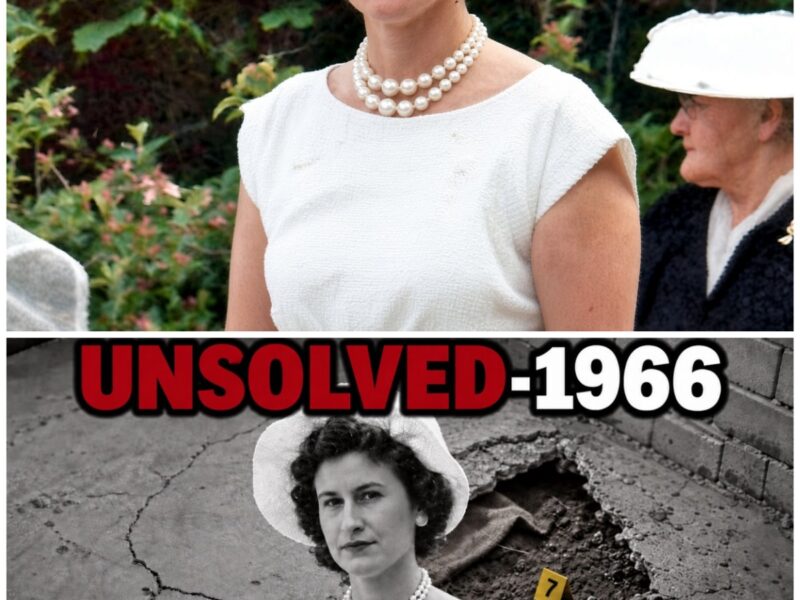
NEW YORK 1966 Cold Case Solved After 52 Years — She Was Under The Cop’s Basement
On the morning of October 6th, 1966, an 11-year-old girl named Sandy kissed her mother goodbye and climbed onto the school bus in Coochog, Long Island.
Her mother, Louise Petravitz, waved from the driveway of the family’s potato farm.
She had two plane tickets to Florida tucked in her bag and $1,200 in cash.
She had told Sandy they were getting away, just the two of them.
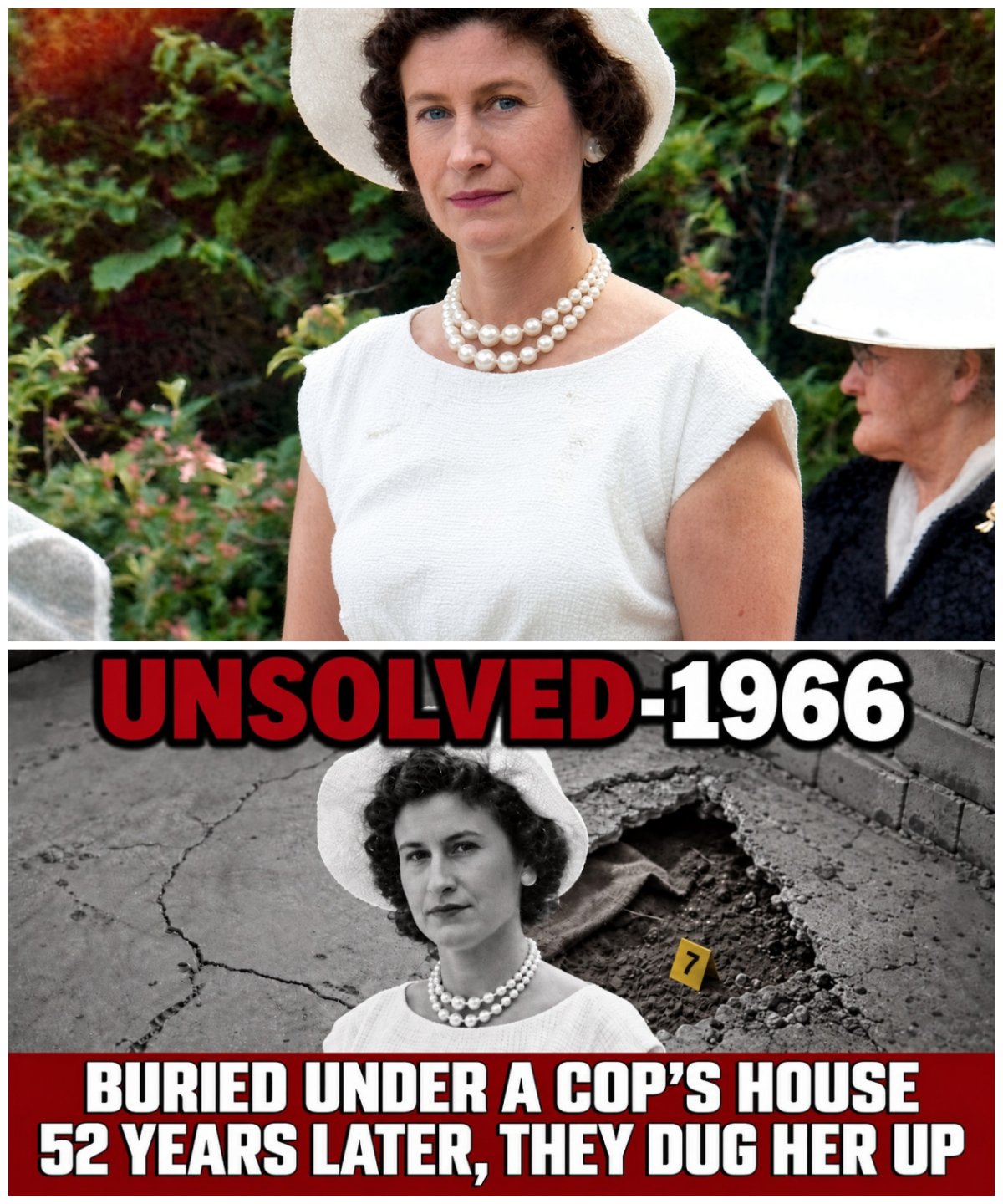
Sandy never saw her mother again.
For 52 years, nobody could explain what happened to Louise Petravitz.
The police didn’t investigate.
The town didn’t talk.
And the one man everyone suspected, a Southold police officer named William Boken, took whatever he knew to a popper’s grave in 1982.
Then in 2017, a tiny weekly newspaper on the North Fork of Long Island published a story.
And that story did something that 52 years of law enforcement never could.
It found Louise.
She had been 7 ft beneath the basement of the man who killed her the entire time.
This is Cold Case Redemption.
And today we’re going back to 1966 Long Island to tell the story of a woman the world forgot. a town that buried the truth alongside her body and the small town newspaper that dug it all back up.
If this is your first time here, we cover cold cases that everyone thought would stay buried and the people who refuse to let them.
Drop a like if you think cases like this one deserve to be told, and subscribe so you don’t miss the next one.
Now, to understand how Louise Petravitz ended up beneath a basement floor in South Hold, you need to know who she actually was before she became a case number.
Before she became a name whispered in farmhouse kitchens across the North Fork, before she became the woman who simply vanished.
Louise Petravitz was born in August of 1928 on her parents’ potato farm in Sagaponac, a quiet stretch of farmland on the South Fork of Long Island.
Today, Sagaponac is one of the wealthiest zip codes in the United States.
A place of oceanfront estates and hedge fund money.
In 1928, it was dirt, flat, sandy fields stretching in every direction, worked by immigrant families who had come to America with nothing and built their lives one harvest at a time.
Louisa’s parents, Alexander and Helena Jashinsky, were Polish immigrants.
They had come to the east end of Long Island and done what thousands of Polish, Irish, and Italian families in the area did during those decades.
They farmed potatoes mostly, long rows of them running parallel to the Atlantic, planted in the sandy lom soil that made eastern Long Island one of the most productive potato growing regions in the Northeast.
Louise grew up alongside her siblings, brothers Leo, Michael, and Walter, sisters Josephine, and Stephanie.
Their childhoods revolved around the farm, planting season, harvest season.
The months in between spent mending equipment, tending smaller crops, and doing the thousand small tasks that keep a family farm running.
By the time Louise was old enough to work the rose herself, she knew every furrow of that Saga Panac property the way most children know their schoolyard.
She could tell you which sections drained well after rain and which ones stayed muddy for days.
That was her world.
Louise was a farm girl through and through, but she was also warm, social, the kind of person people remembered fondly long after she was gone.
She had a natural ease with people that made her good behind a counter and good in a crowd.
She was active in her community.
She joined the Kutchog Fire Department Ladies Auxiliary, which in small Long Island towns during the 1950s was one of the primary ways women participated in civic life.
She showed up.
She volunteered.
She put in the work.
Eventually, Louise moved from the South Fork to the North Fork, settling in Coochoke, another farming community about 40 minutes from Sagaponac if you drove across the island.
She took a job behind the ice cream and soda counter at Turps Pharmacy, a main road fixture in Cuchog, where everybody knew everybody and most conversations happened over a scoop of vanilla or a cherry coke.
Her coworker, MIJ Marcel, would remember standing beside Louise at that counter more than 50 years later.
That’s the kind of impression Louise made.
Not flashy, not dramatic, just present and kind and real.
She also worked the family farm stand on Main Road, selling strawberries and vegetables to the locals who drove past on their way to the vineyards in the sound.
In the summers, the stand would be stacked with flats of berries and bushels of corn.
And Louise would be there making small talk with neighbors, counting change, doing the quiet work of a mid-century Long Island farm wife, which meant doing everything without recognition and without complaint.
Louise raised her daughter Sandy.
She kept her house.
She went to church.
She lived a life that from the outside looked entirely ordinary.
And because it looked ordinary, because she was a farm wife in a small town and not a socialite or a politician or anyone the newspapers would ever have reason to write about, she disappeared from public memory almost as completely as she disappeared from the physical world on October 6th, 1966.
Years later, when journalist Steve Wick finally told her story, he wrote that before his investigation, Louise Petravitz was a nobody, remembered and mourned only by her family.
That sentence lands harder every time you read it.
Not because it’s cruel, because it’s true.
For 52 years, Louise existed only in the memories of the people who loved her.
To the town of Southold.
To the police department that should have found her. to the institutions that should have demanded answers.
She was an inconvenience, a problem that resolved itself when everyone agreed to stop asking questions.
That changes today.
On this channel, we don’t let the forgotten stay forgotten.
And Louise Petravitz has been waiting long enough.
If you’re still here, you already understand why this story matters.
Hit that subscribe button so these cases keep reaching the people who need to hear them.
Because what happened next to Louise is the part that nobody on the North Fork wanted to talk about for half a century.
In 1950, Louise married a Kuchog farmer named Alban Petriitz.
Most people around the hamlet knew him as Al Patrick, an Americanized shorthand for the Polish surname that most of his neighbors couldn’t spell and didn’t try to.
They were married at Our Lady of Poland Roman Catholic Church in Southampton, a parish that served the tight-knit Polish immigrant farming families scattered across Long Island’s East End.
It was a community wedding in every sense.
The same families who farmed together, prayed together, and raised their children together watched Louise and Alvin exchange vows in that church.
They moved into a home on Main Road in Coochog, surrounded by the same flat farmland that had defined Louise’s entire life.
Alvin worked the land.
Louise kept the house and eventually took her job at Turps Pharmacy.
They had a daughter, Sandy.
From the outside, the Piet Treitz household looked like any other North Fork farming family in the early 1950s.
Hardworking, modest, private.
That last word is the one that mattered most, private.
Because behind the doors of that main roadhouse, Louisa’s marriage was violent.
Sandy would later describe what she saw as a child. her father beating her mother, throwing Louise against a wall.
The kind of violence that leaves a child standing frozen in a doorway, watching the one person who is supposed to protect her being attacked by the other person who is supposed to protect her.
Sandy carried those images her entire life.
They never faded.
Children don’t forget what they see in their own homes.
They just learn not to talk about it.
And in the 1950s and early 1960s on Long Island’s North Fork, nobody talked about it.
Domestic violence was not a crime that police departments pursued.
It was not a topic that churches addressed from the pulpit.
It was not something that neighbors intervened in even when they could hear the shouting through the walls.
The phrase that covered everything, the phrase that excused an entire generation of silence was a private matter.
What happened between a husband and wife was a private matter.
What happened to the wife was her problem.
What happened to the children watching was nobody’s problem at all.
There were no domestic violence shelters on the North Fork in 1966.
There were no hotlines.
There were no legal aid organizations specializing in protection orders.
There was no framework, legal or social, designed to help a woman like Louise Petravitz leave a violent husband safely.
You either endured it or you ran.
And if you ran, you went to family because there was nowhere else to go.
Louise left Alban twice.
The first time she came back.
Most women in her situation did.
Not because they wanted to, because the world gave them no alternative that felt survivable.
Leaving meant poverty.
Leaving meant shame in a Catholic farming community where divorce was barely spoken of.
Leaving meant uprooting Sandy from her school, her friends, everything she knew.
So Louise went back and the violence continued.
The second time Louise left was in the summer and fall of 1966.
This time felt different.
This time she took 11-year-old Sandy with her and fled to her parents’ potato farm in Saga Pontac, back across the island to the place where she had grown up.
She wasn’t just leaving Alban this time.
She was leaving the North Fork entirely.
She was making plans.
She had money saved.
She had a destination.
She was done.
And she was seeing someone else.
His name was William Paul Boken.
He was a married South Oldtown police officer who lived on Lower Road in South with his wife Judith and their children.
Bokeen had been on the South Police Force for about 6 years.
By the time Louise disappeared, a figure later cited by Suffach County Chief of Detectives Gerard Gagante, Boken and Louise had likely met the way a lot of people in small North Fork communities met each other during those years, over a counter. at Turp’s pharmacy where Louise worked the ice cream and soda fountain and where a local cop like Boken would have been a regular face.
There’s a version of this story where Bokeen is Louise’s rescue, the strong, confident man who helps her escape a violent marriage and start a new life in Florida.
That may have been how Louise saw it.
She had plane tickets.
She had cash.
She had a plan.
She had told Sandy they were getting away, just the two of them.
But William Boken was not a way out.
He was a second cage.
And this one had no door at all.
Boken was violent, not just occasionally, not just when he was drinking.
Neighbors in Southold had witnessed him drag his wife Judith into the house by force in broad daylight.
He choked Judith in front of their own children.
He once dragged Louise herself into the marital home while Judith watched.
A moment so brazen and so cruel that it tells you everything about how untouchable Boken believed he was.
He kept firearms around the house.
According to later accounts uncovered during the Suffach Times investigation, he maintained a list of towns people he had grievances with.
The people closest to William Boken were not close to him out of affection.
They were close to him out of fear. and Louise was caught between two men who embodied the same violence in different ways.
Alban beat her behind closed doors.
Boken terrorized everyone around him in the open.
She had spent 16 years trying to escape the first one, and in doing so, she had walked directly into the path of the second.
In the fall of 1966, Louise finalized her plan.
She told Sandy the words that her daughter would carry for the rest of her life.
We are getting away, just the two of us.
She purchased two airline tickets to Florida.
She went to the Bridgeampton National Bank and withdrew every dollar from her personal account, $1,273.80.
She closed the account entirely.
She was not planning to come back to the North Fork.
She was not planning to come back to Albin.
She was not planning to come back at all.
The question that nobody could answer for 52 years was whether Louise intended to go to Florida with Boken or without him.
Whether October 6th was supposed to be the beginning of a new life or the end of an old one.
Whether she knew in those final hours that the man she was trusting to help her escape was the most dangerous person she had ever met.
And then came October 6th.
On October 5th, 1966, Louise withdrew that money and finalized whatever preparations she had been making.
She had the tickets.
She had the cash.
She had told Sandy the plan.
Everything was in motion.
The next morning, October 6th, Sandy kissed her mother goodbye and boarded the school bus.
It was a normal Tuesday morning in early fall on the North Fork.
The potato fields along the roads between Cuchog and Sagaponac were brown and picked over.
The air was just beginning to carry the first cold edge off the Long Island Sound.
The bus pulled away and Sandy went to school and Louise Petravitz was left standing on the property of her parents Sagaponac farm with a bag full of cash and a plan to disappear.
Louisa’s sister, Josephine, was the last family member to see her alive.
Josephine watched from the Sagaponac farm as Louise climbed into a car driven by William Boken.
Louise appeared not to want to be seen.
She didn’t wave.
She didn’t stop to say goodbye.
She got into the car and they drove away.
And that was it.
That was the last confirmed sighting of Louise Petravitz alive.
What makes the next part so damning is the timeline.
Boken had called in sick for his three scheduled shifts at the South Old Police Department immediately before October 6th.
Three shifts in a row.
A police officer who had never missed that many consecutive days suddenly couldn’t come to work on the exact days surrounding his mistress’s disappearance.
Then on October 7th, the day after Louise vanished, William Bokeen didn’t call in sick anymore.
He resigned from the South Old Police Department entirely.
No twoe notice, no explanation given to his superiors, no formal transition of his duties.
He simply quit.
One day he was a south old cop, the next day he wasn’t.
The same way Louise was there one day and gone the next.
Think about that for a second.
A married police officer calls out sick for every shift leading up to the day his mistress disappears.
The morning after she vanishes, he quits the force, and nobody in the department raises an eyebrow.
Nobody asks a question.
Nobody connects the two events, or if they did connect them, they decided it was better not to say so.
A few days later, Louis’s purse turned up on the eastbound shoulder of Route 25 in the Calverton and Manorville area, roughly 30 mi west of Kutchog.
The purse was sitting on the side of the road like someone had tossed it from a moving car.
Inside were a World War II savings bond, her social security card, and a postcard bearing the handwritten name of a doctor in Glen Cove, a town on the northshore of Long Island about 60 mi west.
That doctor’s name mattered.
Louise’s family came to believe that she had been pregnant with William Boken’s child, and that the pregnancy was the trigger for whatever happened on October 6th. a married police officer, a pregnant mistress who was about to leave town, a man who already had a wife and children and a reputation to protect.
The family’s suspicion was never confirmed by forensic evidence.
But the postcard was there, the doctor’s name was there, and the question of why Boken would kill the woman he was having an affair with needed an answer.
Pregnancy provided one.
The $1,273 Louise had withdrawn from the bank was gone.
The plane tickets to Florida were gone.
Louise was gone.
And Sandy was standing in her grandparents’ farmhouse in Saga Ponac, waiting for a mother who would never walk through the door again.
Sandy waited through the afternoon, through the evening, through the night.
She waited the next morning, staring out at the driveway where she had last seen her mother.
She waited the day after that and the day after that, and at some point the waiting shifted into something heavier, something permanent. the slow, nauseiating realization that her mother was not coming home, that the plan to get away, just the two of them, was never going to happen, that something had gone terribly wrong on October 6th, and nobody was going to tell an 11-year-old girl what it was.
Decades later, as an adult, Sandy said the thing that every investigator and journalist who ever touched this case would eventually quote, “She would never have just left me.
If she was alive somewhere, she would have called.” Sandy was right.
Her mother hadn’t left.
Her mother was less than 20 m away beneath the floor of a house on a quiet residential street in Southold in a hole that had been dug before she ever arrived there and she would stay in that hole for 52 years.
Louisa’s sisters were the first to sound the alarm.
Within days of Louisa’s disappearance, Stephanie Craidy and Josephine Vinsky drove to the South Oldtown Police Department to report their sister missing.
They got the cold shoulder.
No report was filed.
No officers were dispatched to the Sagaponac farm to interview the family.
No investigation was opened.
No detective drove to Boken’s house on Lower Road to ask him why he had called in sick 3 days running and then quit the force the day after his mistress vanished.
The two sisters were essentially turned away from the front desk of a police department that employed the primary suspect.
The South Oldtown Police Department in 1966 was small, insular, and deeply entangled with the political machinery of the town itself.
The acting chief was Joseph Sawiki, Senior, who held the position from 1964 to 1967.
The department answered to the town supervisor, a man named Lester Albertson, who controlled local appointments and patronage with the kind of grip that small town political bosses have wielded in communities across America for generations.
Southold was his town.
The police department was his instrument, and William Bokeen was one of his officers.
Investigating Bokeh would have meant investigating the department.
Investigating the department would have meant investigating the town’s power structure.
And investigating the power structure was something that nobody in Southold had any interest in doing. 2 weeks of absolute silence passed.
The family got nothing from Southold.
No phone call, no follow-up, no acknowledgement that a woman had disappeared and that the last person seen with her was one of their officers.
So, the sisters did what the South Hold police would not.
They drove to the New York State Police barracks in Riverside and filed a missing person report with investigators who had no loyalty to the Southhole Department and no reason to protect William Bokean.
State police investigators Tom Kobe and Dick Fairchild picked up the case and moved quickly.
It didn’t take them long to identify Boken as their primary suspect.
The timeline made it obvious.
The sick days, the resignation, the purse staged on the highway shoulder, the fact that Josephine had watched Louise drive away in Boken’s car.
This was not a complicated missing person’s puzzle.
The evidence pointed in one direction and one direction only.
Kobe and Fairchild reached out to the South Oldtown Police Department for cooperation.
They got none.
State investigator Dick Fairchild would later describe the situation to a retired state trooper named Bud Griffiths.
He compared the Southole department’s behavior to something out of Payton Place, the melodramatic television soap opera about a small New England town drowning in corruption, secrets, and cover-ups.
Fairchild wasn’t being colorful.
He was being precise.
The South Hold Police Department was not merely failing to cooperate with an outside investigation.
They were actively blocking it.
They were protecting their own.
And the evidence of that protection goes far beyond silence and stonewalling.
The South Old Police BL for the entire year of 1966 later turned up missing from the town archives.
Not misplaced on the wrong shelf.
Not accidentally destroyed in a flood or a fire. gone.
The official description was unaccounted for.
The log that would have documented every call, every dispatch, every incident report, every notation for the 12 months that included Luise Petravich’s disappearance simply ceased to exist.
There is no innocent explanation for a police department losing its own activity records for the exact year that one of its officers became a murder suspect.
No Southole official ever visited Sandy.
No one from the department knocked on a door in Sagaponac to ask the Jashinsky family what they knew.
No one drove to Turp’s pharmacy to interview Louise’s co-workers.
No one pulled Boken’s personnel file or his shift records.
The investigation, such as it was, consisted of doing absolutely nothing and hoping that everybody involved would eventually forget.
But the cover up didn’t peak with inaction.
The most brazen moment came 14 months later.
In December of 1967, state investigator Dick Fairchild phoned the South Old Police Department with a message.
He was driving out to South the next morning to arrest William Boken for the murder of Louise Petravich. 14 months of state level investigation had produced enough for Fairchild to make the trip.
He was coming and he was coming with handcuffs.
That phone call set off a chain of events that would define the coverup for the next 50 years.
That same night, town supervisor Lester Albertson personally ordered one of his officers to pick up William Boken, not on suspicion of murder, on a domestic violence complaint, a wifebeating charge.
Officer Barney Harris drove to Bokin’s home, collected him, and transported him late at night to the private residence of town Justice Ralph Tutill in the nearby hamlet of Matatuck.
What happened inside Ralph Tutill’s Matatuck living room that night was not a legal proceeding by any reasonable definition.
Tootill signed papers committing William Bokeen to a psychiatric hospital.
There was no arraignment.
No defense attorney was present.
No prosecution was represented.
No psychiatric evaluation had been conducted.
No medical professional had examined Boken.
A town justice sitting in his own home after midnight committed a murder suspect to a mental institution on the authority of nothing more than the town supervisor’s instructions.
The next morning when state investigator Fairchild arrived in Southold to arrest William Boken for murder.
Bokeen was locked behind the walls of a psychiatric facility.
Legally unreachable.
The state police couldn’t arrest a man who had been committed by a court order.
Even a court order as dubious as this one.
Boken was beyond their jurisdiction, tucked away in an institution where the state police had no authority to extract him.
Officer Barney Harris, the man who had driven Bokeen to Tutill’s home on Albertson’s orders, would later say he had been used.
He understood eventually what had happened.
Albertson didn’t order the pickup because he cared about Judith Bokeen’s safety.
He ordered it because he needed Bokeen locked away before Fairchild arrived the next morning.
Harris was the delivery vehicle.
Tutill was the rubber stamp.
Albertson was the architect.
And Boken walked away from a murder charge because the town’s power structure decided collectively that protecting one of their own was more important than finding a missing woman.
Boken spent 3 months in that psychiatric hospital.
When he was released in March of 1968, both he and Judith received orders of protection.
He was not arrested.
He was not charged with any crime related to Louisa’s disappearance.
He walked out of that institution and continued his life as though nothing had happened.
The Suffach Times would later call the entire episode a damning portrait of men who behaved like entitled members of a small town good old boys club.
And the men at the center of that club didn’t suffer for what they did.
Town Supervisor Lester Albertson went on to sit on the Suffach County Board of Supervisors and eventually became Suffach County Clerk.
The Siki family remained prominent in local government and law enforcement circles.
The institutional power that had shielded William Boken from arrest didn’t just survive the coverup, it was rewarded.
Years later, journalist Steve Wick would frame his entire investigation around a single question that nobody in the South old power structure had ever been forced to answer. in public.
How did Bill Bowen get away with murder?
The answer was that the people whose job it was to catch him decided instead to help him disappear.
If you believe no case should be buried like this, take a second to hit the like button.
It pushes these stories to more people who need to hear them.
And if you haven’t subscribed yet, now’s the time because what comes next in this story sat hidden for more than 50 years.
After his release from the psychiatric facility in the spring of 1968, William Boken’s life came apart.
Not quickly, not dramatically, slowly.
The way a structure rots from the inside when the foundation is already gone.
Bokeen and Judith divorced.
Whatever relationship they had maintained through the violence, through the terror, through the impossible secret of what lay beneath their basement floor, it did not survive his commitment and release.
Judith took the children.
Bokeen drifted away from the North Fork, away from Southold, away from the farming communities and the familiar faces and the police department that had once shielded him.
He ended up in the New York City area somewhere in the sprawl of Queens, disconnected from everyone who had once known him.
His ex-wife and children had no contact with him for the final 14 years of his life. 14 years of complete silence.
No phone calls, no letters, no visits.
Whatever William Bowen became after he left the North Fork, he became it alone.
In August of 1982, William Boken died in Queens.
He was alone when it happened.
Nobody claimed his body.
The city of New York processed him the way it processes all unclaimed dead.
His remains were transported to Hart Island, a narrow strip of land in the Long Island Sound off the coast of the Bronx, where New York City has buried its unclaimed and unidentified since the Civil War.
Inmates from the Riker’s Island jail complex dig the graves and stack the plain pine boxes three deep in long trenches.
There are no headstones.
There are no markers.
There are no ceremonies.
Just bodies in boxes in the ground, one after another, row after row on an island that most New Yorkers don’t even know exists.
William Boken was buried there with no name on his grave and no family to mourn him.
None of his relatives learned he was dead until 2013, more than 30 years after his burial.
And his ex-wife, Judith, the woman who had spent decades terrified that he might return, who had structured her entire life around the fear that he was still alive and still dangerous, would not learn of his death until 2018.
For 36 years after Boken died, Judith carried her secret in the belief that the man who had threatened to put her in the basement with the other was still out there, still capable of finding her, still capable of following through.
There is a certain grim symmetry in the way Bokeen ended up.
He buried Louise in an unmarked grave beneath a basement.
The city buried him in an unmarked grave beneath an island.
Neither of them was mourned by the town that connected them.
But while Boken was rotting anonymously on Hart Island, the world he left behind in South Old continued turning.
Judith Boken remarried and became Judith Terry.
She built a long and by all appearances respected career in local government, eventually serving for decades as the South Oldtown Clerk.
She processed documents.
She attended town board meetings.
She signed official papers.
She worked in the same municipal building in the same small town where her ex-husband had been a police officer and where the officials who had protected him still held power.
She lived with the knowledge of what was beneath that basement floor every single day.
And she said nothing or almost nothing.
At some point over the years, Judith told one person, just one, Chief Joseph Sowiki, Senior, the same man who had been acting chief of the South Old Police Department when Louise disappeared in 1966.
Judith and the Sowiki family were close.
She was godmother to one of the chief’s children.
And at some point, in some private conversation that no one else witnessed, Judith told Siki that a body was buried in the basement of the house on Lower Road.
Decades later, Siki’s widow, Constance, would confirm this.
She said that her late husband went to the property with two state troopers and dug.
They found nothing.
Whether they dug in the wrong location, whether they didn’t dig deep enough, or whether the effort was half-hearted from the start is a question that nobody has satisfactorily answered.
Louise was 7 ft down.
A casual dig of a few feet would have turned up nothing but sandy Long Island soil.
There were other attempts at that property over the years.
A dig in December of 1967, shortly after Boken’s psychiatric commitment, was described as a few test holes.
A more serious attempt in June of 2013, also came up empty.
Each time, investigators walked away convinced there was nothing to find.
Each time they were wrong.
Louise was there.
She had always been there.
But 7 feet of compacted earth and eventually 5 in of poured concrete were enough to keep her hidden.
Meanwhile, the rest of the cast of characters lived out their lives in the long shadow of October 1966.
Alban Petraich was never charged with any crime.
After Louis’s disappearance, he told state police investigators that he was humiliated by her infidelity and that he didn’t care what had happened to his wife and would be happy to never see her again.
That was his final word on the subject.
He remarried.
He continued farming on Cox Lane in Kuchog.
He worked the same North Fork soil he had always worked.
And he lived the rest of his life without ever being asked to account for the violence he had inflicted on the woman who had once been his wife.
And Sandy.
Sandy grew up without her mother.
She became Sandra Blampede.
She moved to Middletown, New York, a small city in Orange County about 90 mi northwest of the North Fork.
She raised her own family.
She built her own life.
And she carried every single day the absolute certainty that her mother had not abandoned her, that her mother had not run away to Florida without her, that someone somewhere knew what had happened to Louise Petravitz on the morning of October 6th, 1966, and that no one was willing to say it. 52 years is not an abstraction.
It is not a number on a page.
It is Sandy at 12 starting seventh grade in a school where everyone whispers about her missing mother.
It is Sandy at 18 graduating without her mother in the audience.
It is Sandy at 25 getting married without her mother beside her.
It is Sandy at 35 raising her own daughter and wondering every day if this would be the year someone finally told the truth.
It is Sandy at 50, at 60, still waiting, still certain, still unable to prove what she knew in her bones.
That is what a cold case does to a family.
Not just the violence, not just the loss, the silence after it, the decades of unanswered phone calls and unreturned letters and doors that close in your face every time you try to push them open. the slow, grinding realization that the people who are supposed to care about justice decided that your mother wasn’t worth the trouble.
And the hardest part, the part that nobody talks about when they discuss cold cases in the abstract, is that Sandy never had a funeral.
She never had a grave to visit.
She never had the simple, devastating certainty of knowing that her mother was dead and buried in a place where Sandy could bring flowers.
She had nothing, just absence, just an unanswered question that hung over every milestone of her life like a shadow that never moved.
Other people got to grieve.
Other people got to close the chapter and begin the long, painful process of rebuilding.
Sandy never got that.
She was suspended between grief and hope for 52 years, unable to fully mourn a mother she couldn’t prove was dead, unable to move on from a loss she couldn’t confirm.
That kind of limbo does something to a person that is difficult to describe and impossible to undo.
It hollows you out.
It turns every ordinary moment, every birthday, every holiday, every quiet evening when the house is still and the phone doesn’t ring into a reminder of the question you cannot answer.
That was Sandy’s life for 52 years, waiting for someone to care enough to ask the right questions.
In the mid 1990s, a journalist named Steve Wick was working on a book about the farming families of Long Island’s North Fork.
He was interviewing old-timers, combing through land records, piecing together the history of the immigrant communities that had worked this soil for generations.
The kind of slow, patient reporting that doesn’t make headlines, but builds a portrait of a place over time.
And somewhere in that research, someone said a name, Louise Petravich.
It came up the way old secrets come up in small towns, off-handedly, almost casually. a woman who had disappeared in the 1960s, a cop who might have been involved, a case that had never been solved.
It was a footnote in someone else’s story, a passing mention that most reporters would have noted and moved on from.
Steve Wick noted it.
He filed it away and he didn’t forget.
Years later, after Wick became the executive editor of the Suffach Times, a small weekly newspaper based on the North Fork of Long Island, he decided to go back to that name.
The Suffach Times was not the New York Times.
It was not News Day, the large daily paper that covered all of Long Island.
It was a community newspaper, the kind of paper that runs stories about town board meetings and school concerts and the annual strawberry festival.
Its staff could fit in a single room.
Its budget was tight.
Its circulation was hyper local.
Nobody expected the Suffach Times to break a 51-year-old murder case.
That wasn’t what Community Papers did.
But in 2017, that newspaper decided to try.
Wick assembled a small team.
Grant Parin, the PAP’s digital content director, would handle the multimedia production.
Kristen Massa, a multimedia reporter, would work the ground level reporting and Wick himself would lead the investigation, drawing on decades of experience covering Long Island communities and the instinct that had told him 20 years earlier that Luis Petravich’s name was worth remembering.
The three of them began doing what nobody in Southold had done in 51 years.
They knocked on doors.
They pulled courthouse records and property filings and whatever fragments of the public record survived from 1966.
They tracked down aging witnesses who hadn’t been asked about Louise since the Johnson administration.
They sat in living rooms with elderly North Fork residents and listened to stories that had never been told on the record.
They drove to Sagapanak and talked to the Jashinsky family.
They reconstructed piece by piece the full timeline of what had happened in October 1966 and what the South old power structure had done to bury it.
In October of 2017, 51 years and a few weeks after Louise vanished, the Suffach Times published everything.
The report was titled Gone.
It ran 10,000 words in print, hitting news stands on October 26th, 2017.
Alongside it, Parpan and NASA released a three-part documentary film that would later be extended to four chapters and 71 minutes of total runtime.
The investigation named William Boken as Louis’s killer.
It documented the Southold Police Department’s refusal to investigate.
It detailed the midnight psychiatric commitment.
It identified the missing 1966 police blotter.
It named the officials who had participated in the coverup.
It told the story that an entire town had spent half a century refusing to tell.
The response was overwhelming for a paper that size.
Gone drew more than 20,000 page views online, a number that would have been remarkable for a regional daily paper, let alone a weekly with a staff of three.
The subsequent story about the discovery of the remains pulled more than 30,000.
For a newspaper whose biggest story in a typical month might crack 15,000 views, those numbers were unprecedented.
They meant that people were reading, sharing, and talking about Louise Petravitz for the first time in half a century.
The documentary screened to packed audiences at libraries and community centers across the east end of Long Island.
Standing room only.
People who had lived in South Hold their entire lives sat in folding chairs in library meeting rooms and watched a film about a murder and a coverup that had been sitting in plain sight in their community for over 50 years.
Some of them remembered Louise.
Some of them remembered Boken.
Some of them had heard the rumors decades ago and assumed like everyone else that nobody would ever do anything about it.
The Gone series won multiple journalism awards and became one of the most significant pieces of investigative reporting in the history of Long Island community journalism.
Steve Wick told a reporter from Pointer, “Just Us caring brought an amazing result.
If you’re a community newspaper, that’s a home run.” And investigative journalist Jerry Mitchell, whose own decades of reporting in Mississippi had cracked open multiple civil rights era cold cases, made an observation that captures exactly why gone mattered.
Local reporters are able to crack these cold cases that authorities don’t or won’t touch.
The South Old Police Department, confronted with a 10,000word public accounting of their own institutional failure, reopened the investigation into Louise Petravich’s disappearance. 51 years after they had turned her sisters away from the front desk, they finally assigned detectives to the case.
What the Suffach Times accomplished was not a miracle.
It was not a forensic breakthrough or a technological revolution.
It was something much simpler and much more damning.
Three journalists working from a small office on the North Fork did the basic investigative work that every institution with the authority and obligation to find Louise Petravitz had deliberately refused to do for more than half a century.
They asked the questions.
They knocked on the doors.
They read the records.
They gave a damn.
And that turned out to be enough.
On February 16th, 2018, four months after Gone was published and the world learned what Southold had buried, Detective Sergeant John Sinning of the South Oldtown Police Department and retired Detective Joseph Conway Jr. sat down with Judith Terry for a formal interview.
Judith was 83 years old.
The early stages of dementia were beginning to erode her memory in the diffuse, frustrating way that the disease works.
She would lose track of a thought mid-sentence.
She would struggle with names and dates that had once been automatic.
The texture of her daily memory was fraying.
But there are memories that dementia does not reach easily.
Memories forged in extreme trauma have a different neurological architecture than ordinary recollections.
They are encoded more deeply, more vividly, burned into the brain by adrenaline and cortisol. and the raw survival instinct of a person who believes they are in mortal danger.
The memory of what Judith Terry had witnessed in the basement of the house on Lower Road in Southold was one of those memories.
It had survived 36 years of fear.
It had survived decades of silence.
It had survived the onset of a disease designed to erase the past.
And it survived the interview with detectives Sinning and Conway.
But first, the detectives had to break through the wall that Judith had built around that memory for 52 years.
And the key to that wall turned out to be a single piece of paper.
The detective showed Judith Boken’s death certificate.
For 52 years, Judith Terry had believed William Boken was alive.
She had believed that the man who had murdered Louise Petravitz, the man who had choked her in front of their children, the man who had threatened that Judith would end up in the basement with the other if she ever told anyone what she knew, was still out there, still breathing, still dangerous, still capable of finding her and making good on his promise.
Her silence had not been the silence of a co-conspirator.
It had been the silence of a hostage.
When Judith saw that death certificate, something shifted.
You could almost hear it.
The sound of a lock turning after 52 years.
Boken had been dead since 1982.
He had been lying in an unmarked trench on Hart Island for 36 years while Judith sat awake in her home on the North Fork, listening for footsteps that were never going to come.
Every night she had spent afraid.
Every door she had double-cheed.
Every time she had swallowed the truth to protect herself from a dead man’s threat, all of it had been unnecessary.
The man she feared no longer existed.
He had been gone for longer than he had been a presence in her life.
The wall that had sealed her testimony for half a century lost its foundation in a single moment in a small room with two detectives watching.
According to the detective notes later released through a Freedom of Information request, Judith began to describe what she had seen.
Her account was specific.
Her memory of the basement layout was detailed and precise despite the dementia.
She described Boken bringing Louise’s body into the basement of the lower roadhouse.
The body was wrapped in burlap.
Boken forced Judith to untie the cords around the burlap wrapping.
He then rolled the body into a hole in the dirt floor of the basement, a hole he had dug before Louise ever arrived at the house.
East Hampton psychotherapist Mary Bramley, who had worked extensively with survivors of kidnapping and domestic violence and was a founder of the retreat domestic violence shelter on the east end, later explained the psychological mechanism that allowed Judith to keep this secret for 52 years. shame, isolation, post-traumatic stress disorder sustained over decades, intense, unrelenting fear, and dissociation.
The survival mechanism by which the mind walls off unbearable experiences and allows a person to continue functioning, to go to work, to raise children, to serve as a town clerk in the very community where the murder occurred while carrying knowledge that would destroy them if they allowed themselves to fully feel it.
Judith Terry was not an accomplice.
She was a victim of the same man who had killed Louise.
The violence Boken inflicted on Judith before, during, and after the murder created a prison of silence, as effective as any physical confinement.
The difference between Judith and Louise was not one of character or courage.
It was one of outcome.
Louise didn’t survive to be silenced.
Judith survived, and the silence became her life sentence.
Armed with Judith’s testimony and a handdrawn diagram of the basement she provided to investigators, the team went to the former Bokeen property in Southold on March 15th, 2018.
The basement, which had been a dirt floor in 1966, had been topped with roughly 5 in of poured concrete at some point in the intervening decades.
Investigators broke through the concrete, dug into the earth beneath, and found nothing.
They regrouped.
They studied Judith’s diagram more carefully.
They brought in ground penetrating radar and sonar equipment to map anomalies beneath the floor.
They recalculated the depth based on Judith’s description of how deep the hole had been.
On March 19th, 2018, they returned.
At approximately 6 1/2 ft below the basement floor, a worker’s shovel struck something solid.
A jawbone human.
They kept digging carefully now, methodically, inch by inch, through compacted sandy soil that had not been disturbed in more than half a century.
Nearly 7 ft down, they found a complete skeleton.
The remains were wrapped in burlap exactly as Judith had described.
Around the bones, investigators recovered fragments of a brightly colored dress, a blouse with three distinct bullet holes through the fabric, a slip, and a garter.
The clothing was decomposed but identifiable.
And alongside the remains, partially corroded but unmistakable, were two 38 caliber bullets.
The South Oldtown Police Uniform Code, adopted in 1965, one year before Louise’s murder, stipulated that all officers were required to carry 38 caliber revolvers while on duty.
Louise Petravitz had been beneath the floor of her killer’s house for 52 years. through every winter that froze the ground above her.
Through every spring that thaw it, through Sandy’s entire childhood, adolescence, adulthood, and middle age, through the cover up and the silence and the missing blotter, and the psychiatric commitment, and every institutional failure that kept her hidden, 7 ft down in a burlap sack in the dark the entire time.
The DNA results came back on April 14th, 2018.
Samples taken from Louisa’s brother, Leo Jashinsky, who was in his early 90s and still living, and from her daughter, Sandy, confirmed what everyone already knew, but science needed to make official.
The remains belonged to Louise Petravitz.
The Suffach County Medical Examiner ruled the cause of death as homicidal violence.
Gunshot wounds to the torso, three gunshot wounds, three 38 caliber bullets matching the standard issue sidearm of a South Oldtown police officer.
In 1966, Suffach County Police officially declared the homicide closed and attributed the killing to the deceased William Boken.
No living person was charged.
No grand jury was convened.
No official in South Hold’s chain of command faced consequences for the cover up that had kept Louise buried for more than five decades.
The man who pulled the trigger had been dead for 36 years, decomposing in a mass grave on an island in the Long Island Sound, beyond the reach of any courtroom, any jury, any sentence.
On May 5th, 2018, Louise was cremated and memorialized at Coaster Heapner Funeral Home in Kutchog.
The same small town where she had sold strawberries at the farm stand.
The same town where she had served ice cream cones at Turps Pharmacy.
The same town where she had waved goodbye to Sandy on a Tuesday morning in October and never come back. 52 years after she was last seen alive, Louise Petravich was finally laid to rest.
Sandy was there.
She was 63 years old.
She had spent 52 of those years waiting for this day, not knowing if it would ever come, not knowing if anyone would ever care enough to look.
But Sandy was not finished.
In March of 2019, Sandra Blampede filed a notice of claim against South Hold Town and its police department.
Represented by the law firm Rosenberg and Gluck of Holtzville, Sandy alleged she had suffered loss of sephiler and mental anguish as a direct result of the town’s negligence, carelessness, gross negligence, and recklessness.
The notice of claim was the legal precursor to a lawsuit.
And it represented something that 52 years of institutional silence had tried to prevent accountability.
Not for Boken, who was beyond reach, but for the system that had protected him.
The officials who had ordered the midnight psychiatric commitment.
The department that had lost its own records. the town that had turned two grieving sisters away from the police station and told them through silence and inaction that their sister’s life didn’t matter enough to investigate.
The Suffach Times ran an editorial calling for a grand jury investigation into the cover up.
They argued that even with Bokeen dead, the question of how and why an entire municipal government conspired to obstruct a murder investigation deserved to be examined under oath on the record with the weight of a legal proceeding behind it.
As of the final reporting on this case, no grand jury was ever impanled.
The Siki family defended the late chief’s conduct as exemplary.
The town’s official posture remained what it had been for 52 years.
Silence.
But silence lost.
That’s the part of this story that matters most.
Not the murder, as terrible as it was.
Not even the cover up as infuriating as it remains.
The part that matters is that silence lost.
A weekly newspaper with a staff of three cared enough to ask the questions that an entire police department had spent half a century avoiding.
A daughter who was 11 years old when her mother disappeared never stopped believing that the truth was out there.
An 83year-old woman with dementia found the courage to speak when she learned that the man she feared was already dead.
Louise Petravitz sold strawberries at a farm stand on Main Road.
She scooped ice cream at Turpp’s pharmacy.
She joined the lady’s auxiliary.
She raised a daughter who loved her.
She tried to escape a violent marriage and trusted the wrong man to help her do it.
And for 52 years, the town where she died decided that none of that was worth investigating.
Steve Wick wrote something about Louise after Gone was published that deserves to be the final word on what that investigation accomplished.
He said that before his reporting, Louise Petravitz was a nobody remembered and mourned only by her family.
After it, she became a real person for the very first time.
A 38-year-old woman, a mother, a sister, an aunt, a wife.
That is what Cold Case Redemption is about.
Not just solving the case, restoring the name, giving back to the dead what the living tried to take from them.
Louise Petra Vitz was not a case number.
She was not a footnote.
She was not an inconvenience to be buried and forgotten.
She was a mother who kissed her daughter goodbye on a Tuesday morning and deserved better than 52 years of silence.
Every case on this channel went cold because somebody decided it wasn’t worth pursuing.
And every case on this channel was eventually solved because somebody else decided it was.
If you believe the forgotten deserve to be found, subscribe so you’re here for the next one.
And leave a like for Louise.
I’ll see you in the next one.