Sheriff’s Wife Vanished in 1997 – 21 Yrs Later, Her Son Found Her Photo in His Dad’s Evidence Locker
In the winter of 1997, in a quiet cattle town in Wyoming, a sheriff’s wife vanished without a trace.
Her husband and her young son searched everywhere.
But investigators found no evidence of a struggle, and the case quickly went cold. 21 years later, a single discovery changed everything.
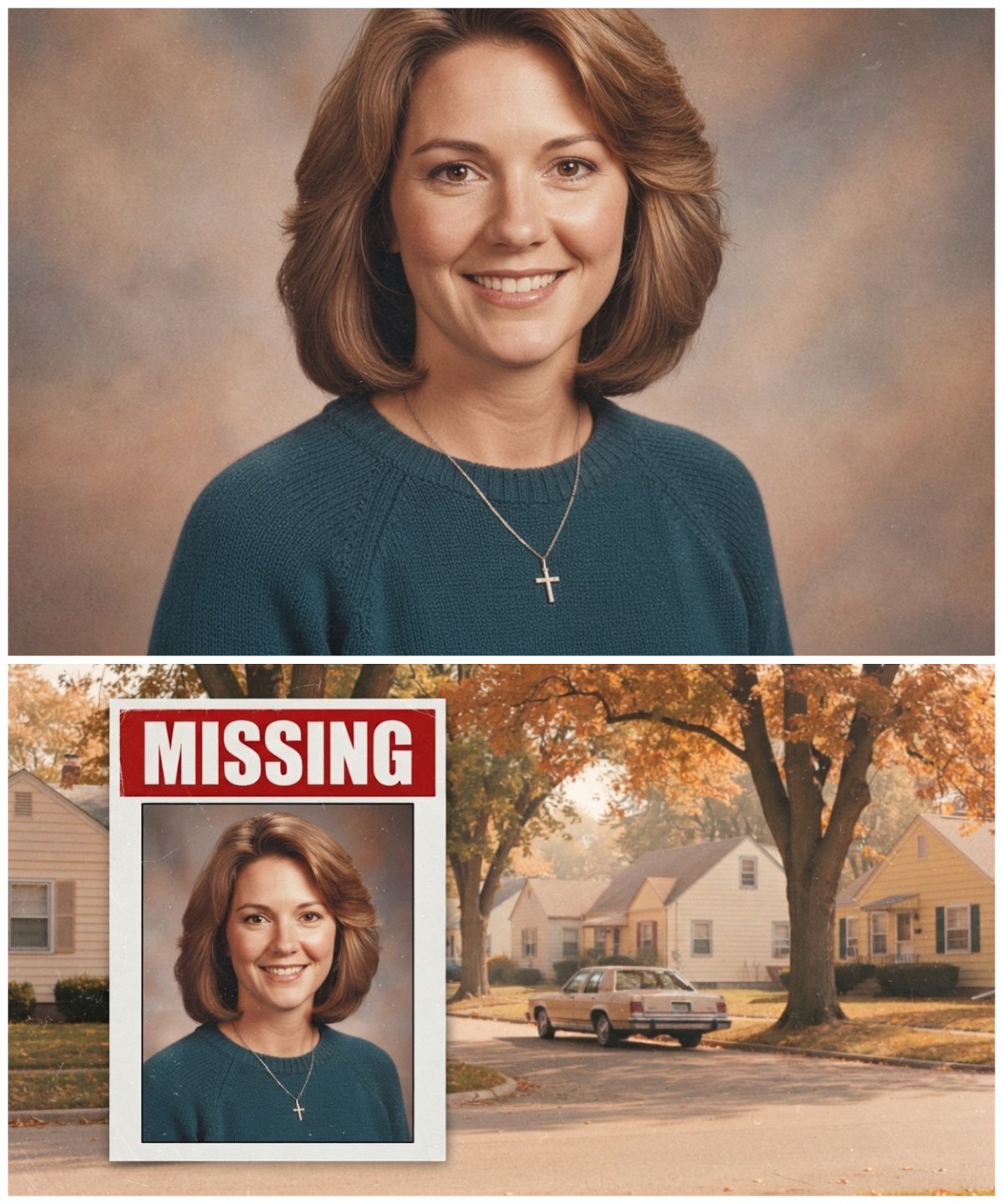
Her son, clearing out his late father’s evidence locker, found a photograph of her taken long after she disappeared.
What they found exposed a secret no one was prepared for.
Sweetwater Junction, Wyoming, sat where the prairie rolled up against the foothills, a town of 2600 where people rarely locked their doors.
Cattle trucks rumbled down Main Street before dawn.
The diner served pie until 9.
And at the end of Cottonwood Lane, in a tall white house with a wide front porch, lived the sheriff’s family.
Diane Callahan was 33 years old.
She was the school nurse at Sweetwater Elementary, the kind of woman who kept butterscotch candies in her pocket for scraped knees and homesick children.
Every evening without fail, she switched on the porch light and left it burning until her husband was home.
And she carried an old Polaroid camera everywhere, taking pictures of the rodeo queen, the mail carrier, the first snow on the courthouse roof.
She pinned them all into an album she called the book of Sweetwater.
Her husband, Ray Callahan, was 36 and had been sheriff for six years.
He was big and calm and slow to anger.
A law man who knew every rancher by name and had never once drawn his gun on a neighbor.
Their son Caleb was nine, a gaptothed boy who collected arrowheads and followed his mother like a shadow.
On the Saturday before Christmas of 1996, Diane dragged Caleb to the courthouse lawn to pose in front of the big spruce tree.
She balanced the Polaroid on a fence post, set the timer, and squeezed in beside her son.
The camera clicked and worried.
She took two pictures, one right after the other.
In the first, Caleb was crossing his eyes, and Diane was laughing so hard her hat had fallen off.
She pressed one into Caleb’s mitten hand.
Keep this in your coat pocket until you’re all grown up, she said.
And promise me that one day you and I will stand right here and take another one with the very same silly faces.
I promise, Caleb said.
He meant every word.
But in early January, something changed.
It was small.
It was so small that Caleb almost missed it.
His mother grew quiet at supper.
She stared out the kitchen window while her coffee went cold.
Twice he saw her sit in the car in the driveway for 10 minutes with the engine off, watching the rear view mirror.
When his father asked what was wrong, she smiled and said she was just tired.
She barely slept.
She barely ate.
On the last Saturday before it happened, she asked Caleb to skip his best friend’s sleepover and stay home with her instead.
Caleb groaned.
“Mom, everybody’s going, please.” Diane looked at him for a long moment.
Then she kissed his forehead and helped him pack.
Looking back, Caleb would spend the rest of his life wondering if that decision sealed his mother’s fate.
The morning of Thursday, January 16th, 1997, was bitterly cold with fresh snow squeaking on the porch steps.
The whole house smelled of wood smoke and hot waffles.
Diane stood at the stove in a green wool cardigan, humming softly.
At the door, she wrapped a gray scarf twice around Caleb’s neck and straightened his collar, the way she always did.
I’ll pick you up at 3:15, she said.
Wait for me right at the front door, okay?
I always do.
She held him a moment too long.
Her eyes looked bright and strange.
Good.
Now go.
You’ll be late.
He hurried out into the snow.
He did not look back.
Why would he?
It was an ordinary Thursday.
At a quarter 3, his teacher asked him to stay 5 minutes to finish a spelling test.
Caleb sighed and rode as fast as he could.
Then he grabbed his coat and ran to the curb.
The green Buick was gone.
He waited on the front steps in the falling snow. 10 minutes, 20.
His mother was never late.
Finally, a friend’s mother pulled up in her station wagon and drove him home.
Looking back, he would replay those 5 minutes 10,000 times, wondering if they had cost him everything.
It was nearly 5, and the sky had faded to slate when the station wagon stopped in front of the house.
The house was dark.
The porch light was off.
Caleb stood on the walkway.
His mother always left a light on.
Always.
Every night of his life, that little yellow bulb had been shining.
The front door was unlocked.
He called her name.
Silence.
He ran to the kitchen.
Empty her bedroom.
Empty the basement stairs.
Nothing.
His heart began to pound.
The neighbor took his hand and said nothing at all.
Ray Callahan arrived within minutes, still wearing his badge.
He went through the house room by room, calling her name.
Her purse was gone.
Her green Buick was gone.
Her Polaroid camera sat on the kitchen shelf, its lens capped neatly in place.
Nobody had seen her since the morning.
At 8:00, Ray’s under sheriff, Vernon Gered, arrived with two deputies.
He was a heavy, smiling man with a voice like warm gravy.
He put a hand on Ray’s shoulder.
“You’re too close to this, Ry.
Let me run it.
She’s a grown woman, and adults are allowed to leave.
Give her until morning.” She would never leave Caleb, Rey said.
Gity squeezed his shoulder a little too tightly.
Gity’s deputy took the report the next morning and wrote a single line, “Voluntary absence.” But by Friday afternoon, Rey had called the state police himself.
Those were the longest two days of Caleb’s life.
He sat at the top of the stairs in his coat, waiting for the front door to open.
On Saturday, the state finally took it seriously.
Bulletins went out across four counties.
Neighbors walked the fields in lines.
A helicopter swept low over the frozen creek and tracking dogs arrived from Cheyenne.
On Saturday afternoon, a rancher reported a green Buick parked alone beside the abandoned Sugarbeat loading station off Highway 20.
It was Dian’s car.
The doors were locked.
The seats were tidy.
There was no broken glass, no torn fabric, no sign of a struggle.
It looked as though she had parked it and simply walked away.
The dogs picked up her scent at the driver’s door.
They followed it across the gravel to the shoulder of the highway.
And there they stopped.
They circled.
They whed.
The scent was gone as if Diane had simply evaporated into the cold January air.
Nobody in Sweetwater Junction had ever seen the sheriff look so small.
Before we continue, if this story has kept you watching, please subscribe.
Your support truly means a lot to us.
But something didn’t feel right.
State investigator Gordon Pike, a lean, greyeyed man who wrote everything in a small black notebook, took over the case that night.
He stood beside the locked car for a long time, hands in his pockets.
Then he said quietly, “People who run in a hurry forget to lock the car.
Either she planned this, sheriff, or someone wants us to think she did.” 2 days later, the school secretary sat in the Callahan kitchen, twisting a tissue.
Something Diane had said the week before kept coming back to her.
Looking at the book of Sweetwater, Diane had murmured, “Some pictures are dangerous to keep and more dangerous to throw away.” The secretary had thought she meant an old snapshot of somebody’s ex.
“Now,” she whispered.
She was not so sure.
Weeks passed.
The volunteers went home.
The helicopter stopped flying, but Ry could not stop looking.
Night after night, he sat in the kitchen with the book of Sweetwater, hoping his wife had left him an answer.
In February, taped beneath the bottom of her nightstand drawer, he found a small brass key.
Stamped on it was a single number, 14.
Beside the key was a torn scrap of paper with three words in Dian’s handwriting.
Bus depot.
Thursday, Pike opened locker 14 at the Sweetwater Bus depot with Ray standing beside him.
It was empty.
Someone had rented it for a full year, paying in cash, and the ticket clerk remembered only a thin gray man in wire glasses who kept his eyes on the floor.
It was a small lead, and it ended almost as quickly as it began.
Then Ry noticed something else.
Two of Diane’s warm winter sweaters were missing along with her good boots and the little silver frame from her nightstand.
Nobody takes a picture frame to go shopping.
Pike wrote it down slowly.
It didn’t fit any story yet.
A month later, the school secretary came to the state police office, pale and trembling.
She had been carrying a secret, and it had grown too heavy.
Three days before Diane vanished, she said unsure if Gity had come to the school.
He asked to speak to Diane in the nurse’s office and he closed the door.
When Diane came out, her face was gray.
Please don’t ever ask me about that visit, she had said.
So the secretary never did.
And she had never forgiven herself for staying silent.
It was the first real clue. but it led nowhere.
Gity told Pike he had only stopped by to plan a school safety talk.
Nobody could say otherwise.
Then weeks later, a bank in Casper sent Pike a record that stopped him cold. 4 days after Diane’s car was found, someone walked in and withdrew every dollar from the Callahan savings.
Dogs were still searching the creek beds that day.
Ry was still sitting by the phone. $1,600 in cash.
The timeline was impossible to ignore.
The slip carried Diane’s signature, but the teller remembered the person who handed it over, a thin gray man in wire glasses with a cardigan buttoned to the collar.
Only one man in Dian’s life fit that description.
Lester Bright had been the sheriff’s department evidence clerk for 30 years. a quiet, careful man who had taught Ry everything he knew.
He had held Caleb at his baptism.
Rey had called him family.
When Pike said the name aloud, Ry refused to believe it.
Lester’s the most honest man I know.
He would never hurt her.
“I hope you’re right.
But right now, he’s the only man who knows where she is,” Pike said.
Pike drove to Lester Bright’s little apartment above the hardware store with two troopers.
No answer.
The landlord let them in with a key.
The rooms were bare.
The bed was stripped.
The closet was empty.
He said Lester had left in January.
Paid his rent through June in cash and never said where he was going.
They had missed him.
Standing in that bare silent room, Ry felt the last solid piece of his world give way.
If you want more emotional cold case stories like this, please subscribe.
Your support truly means a lot to us.
But the most disturbing piece of information was yet to come.
Pike pulled the sheriff’s department radio log for January 16th.
Every patrol car had checked in on schedule except one.
Under Sheriff Gered’s unit went silent at 3:30 that afternoon and did not come back on the air for 90 minutes. 980 minutes and Highway 20 ran straight through the middle of them.
For months, Pike hunted Lester Bright through six states.
Nothing.
Lester had vanished as completely as Diane.
Then Pike asked to question Gity under oath.
The county attorney refused.
The state attorney called it a coincidence and a grieving husband’s grudge.
Within a year, Pike was reassigned to a case in Cheyenne.
He was left with a locked car, an empty locker, a brass key, and a sheriff who could no longer trust the men who wore his badge.
The investigation hit a massive, immovable brick wall.
Years passed.
The town slowly stopped asking, then it stopped talking about it.
Pike retired in 2004, and when he cleaned out his desk, he took a copy of the Callahan file home.
He could not bear to see it forgotten in a basement box.
For 21 years, nothing, no calls, no letters, no sightings.
Pike grew old.
Ray wore the sheriff’s badge until 2016.
Caleb came home from college to teach history at the high school.
Through it all, Ray switched on the porch light every night, and the Polaroid stayed in Caleb’s wallet, soft as cloth.
Then, in the autumn of 2018, Ray Callahan died in his sleep.
A month later, a young records clerk was clearing out the basement of the old county jail before the building was torn down.
Locker number nine had Ray Callahan’s name on it. she called Caleb and he drove down in the rain with his father’s key ring.
The clerk watched him turn the key.
Inside, on an otherwise empty shelf, sat a thick accordion folder and a single manila envelope sealed with tape.
On the front, in Ray’s heavy handwriting, was one line for Caleb.
Read this alone.
She saw him sit down on the cold concrete floor.
She saw his hands begin to shake.
Then she quietly closed the door and left him alone.
Inside the envelope lay a small square Polaroid faded at the edges.
It showed a woman of about 40 in a blue coat standing on a windy fairy dock with gray beginning to streak her dark hair.
She was smiling a shaky crooked smile.
And in her raised right hand, she held up a second older Polaroid. a laughing woman and a boy with crossed eyes in front of a Christmas tree.
Caleb reached into his wallet with numb fingers.
There, worn soft as cloth after 21 years, was the very same picture, the same creases, the same silly faces.
He turned the new photograph over.
On the back in handwriting he had not seen since he was 9 years old were six words.
Ray, tell Caleb I kept mine.
And below them, keep the light on.
Beneath the Polaroid lay a sheet of lined paper in Ray’s heavy handwriting.
Caleb, if you are reading this, I am gone.
And I owe you the longest apology of my life.
Your mother sent this in 2004.
I never told you because a man was watching this family and I could not risk losing you both.
Forgive me.
Find her.
The next morning, Caleb carried the envelope into the state cold case unit in Cheyenne.
The detective who met him was Detective Okafor, 29 years old, with a laptop tucked under one arm.
She had been in second grade when Diane vanished.
Okapor listened without interrupting.
Then she went down to the basement archive, wiped thick dust off four cardboard boxes, and began to read.
Page after page, she found the same blue ink handwriting in the margins.
Investigator Pike’s notes.
Who is LB?
Where did the frame go?
And on the last page, underlined twice, Gity knows.
Someone will prove it.
In 1997, a fingerprint took weeks to trace.
Now Okaphor could search records across 50 states in seconds.
She called Pike, now 80 and living in Montana.
When she said the name Callahan, the line went quiet.
I’ve been waiting 21 years for this call.
He finally said, “Binder Detective Okafor started with the photograph.
The state crime lab read the film’s edge code and dated the Polaroid to the spring of 2004 under magnification.
Behind the woman’s shoulder, they found a handpainted sign, Ren Island Ferry, Last Boat 610.
Inside Ray’s accordion folder, Okafur found the original mailing envelope addressed to Ray in Block Capitals.
The postmark read Ana Courts, Washington.
There was no return address.
The same envelope had once carried a 100 pages of photocopied evidence room ledgers.
Dozens of entries were circled in red.
Cash seized in drug cases.
Rifles taken in a ranch raid.
Each item had been signed in and never signed out except by one set of initials.
VG Ray had spent 14 years quietly building a case against his own under sheriff and he had died before he could finish it.
Okafur traced the ferry.
Ren Island was a rocky speck of 400 people.
She searched the island’s records for women who had arrived in 1997 and found one, Marian Low, who had come ashore that spring, telling the clerk that a house fire had destroyed all her papers.
Marian ran a tiny photography studio near the ferry landing.
She was 54.
But something was wrong.
Marian Low had no records before 1997, no birth certificate that matched, no school records, no family.
Her island driver’s license had been issued on the strength of a notorized letter from a man who called himself her uncle.
His name was Lester Bright.
Then Okafur found the last piece.
Lester Bright had died on Ren Island in 2011 in a tiny clinic beside the fairy landing.
The name on his death certificate, listed as his sole family, was Marian Low.
Okafor spread Pike’s old notes across her desk and laid them beside the new pieces, the brass key and the empty locker, the $1600 in cash, the missing sweaters and the little silver frame, the car parked and locked.
The dogs losing the scent at the highway where a second vehicle could have been waiting.
Mary and Lo’s paper trail began just weeks after Diane’s ended.
Suddenly, the pieces snapped together.
They had a plan.
Nobody had dragged Diane away.
She had left on purpose.
That evening, Okafor drove to Caleb’s small brick house in Sweetwater Junction and spread everything across his kitchen table.
He listened without a word, staring at the faded Polaroid of a woman on a fairy dock.
My mother wouldn’t leave me, he said at last.
Not like that.
Not without a word.
I believe she loved you, Okafer said gently.
But everything here says she planned it.
And someone helped her.
Caleb’s hands began to shake.
For 21 years, he had pictured a hundred terrible endings.
He had never once imagined this one.
But this realization only created a massive new question.
Why would a mother walk away from a 9-year-old boy and stay gone for 21 years?
Nobody in that kitchen had an answer, and the silence felt heavy and long.
Before we continue, if this story has kept you watching, please subscribe.
Your support truly means a lot to us.
Before she left, Okafer chased the last loose thread in Pike’s file, Vernon Geredity.
It took her 11 minutes.
He had retired in 2016 with a full pension and a county commenation, and he lived on a ranch 8 mi from Caleb’s house.
Okafur sat very still.
Suddenly, she understood the kind of fear Diane might have lived with.
Caleb asked to come along.
Okapor told him gently that he had to wait.
Whatever Diane had to say, he deserved to hear it from her, not from a report.
He walked Okafur to her car, gripping the porch rail.
The porch light was already on, though it was still afternoon. 2 days later, Okafur drove to Anacourtz and rode the last ferry into the gray water.
Ren Island rose from the fog. a scatter of shingled houses beneath dark furs.
At the end of a gravel lane stood a small cottage with a blue door and a handlettered sign.
Low photography.
It was noon on a windy day and on the porch a light was burning.
Okafor stood there for a long moment.
Then she knocked.
Footsteps came slowly.
The door opened.
A woman with graying dark hair stood there. a camera hanging around her neck.
She looked at Okafor’s badge.
Then she looked at Okafor’s face.
The color drained from her cheeks and her hand rose to her mouth.
For a long time, neither of them spoke.
I knew someone would come one day, the woman finally said.
Her voice trembled.
I’ll tell you exactly why, and I’ll tell you where I’ve been all these years.
Inside the cottage, they sat at a worktable covered with photographs and tiny brushes.
The woman poured tea with trembling hands.
“My name is Diane Callahan,” she said.
“I have rehearsed this for 21 years now.
I can’t remember a word.” Okafur waited.
And slowly Diane began at the courthouse Christmas party, she said.
She wandered behind the building with her Polaroid and snapped under Sheriff Gerity loading sealed evidence crates into an unmarked truck.
She took the picture to Lester Bright, the evidence clerk, and he went pale.
For years, cash and guns had been vanishing from the room he guarded.
And for years, he had quietly copied the ledgers, afraid to tell anyone.
But somehow Gity found out.
On Monday, January 13th, he came to the school and closed the nurse’s office door.
No judge in the county would take a nurse’s word over an under sheriff’s, he said.
And then he mentioned with a smile that Caleb sometimes walked home alone through the icy alley behind the school.
Accidents, he said, happened all the time to boys that age.
She could not tell Rey.
He would have gone after Gered that very night.
And Ged’s men were the only backup Ry had on those empty winter roads.
So she went to Lester.
He told her a man like Gity could threaten a woman he could see and a boy he could reach.
“He can’t threaten a ghost,” Lester said.
“Vanish, Diane, and take that photograph with you.
He’ll spend years hunting a woman he can never find.
I’ll keep copying pages until it’s safe to tell the truth.
She taped the bus depot key beneath her nightstand, a single thread for Ray to pull.
One day, Lester emptied the locker that afternoon.
On January 16th, she drove to the school at 3:15 to say goodbye.
She sat at the curb and watched Caleb through the classroom window, frowning over a spelling test, chewing his pencil.
If he had walked out through the doors in that moment, she told Okaphor, she would have taken him and everything would have fallen apart, but the teacher kept him five more minutes.
She watched him a little longer and she drove away.
She had switched on that porch light every evening for 12 years.
Leaving it dark, she said, was the hardest thing she had ever done.
She drove to the old sugarbeat station, locked the Buick, and crouched behind a rusted tank while a county cruiser rolled past on Highway 20.
Then she walked to the road where Lester’s brown sedan waited with its lights off.
He did not say a word.
She climbed into the back seat and he reached back and held her hand all the way to the coast.
She cried until she had no tears left.
On Ren Island, she became Marian Low, the name of her grandmother.
She could not touch a Polaroid again, so she bought a used film camera and photographed fishermen, brides, and babies.
Her days were quiet.
Her nights were long.
Twice a year, Lester traveled to Wyoming to watch from a distance.
He always brought back the same news.
A county truck idled on Cottonwood Lane some nights.
And the porch light was always burning.
One letter or one phone call, and Ged could have followed the trail straight to the island.
So, she stayed silent.
In 2004, she risked a single photograph mailed to Ray with Lester’s ledger pages, and she never dared to write a return address.
Lester died in 2011.
Gity retired in 2016.
She should have felt free.
Instead, she felt terrified. 20 years had passed, and Rey, she was sure, had built a new life.
Then, four weeks ago, she read Ray’s obituary on the library computer.
He had died in his sleep, it said, survived by his son Caleb and by his wife Diane, whom he had never stopped waiting for.
Rey had never remarried.
He had never stopped believing.
She was packing a bag when Okafur knocked.
She rose and returned with a small tin box.
Inside lay 21 photographs, one for every January 16th. each showed a single lamp glowing in a dark window, and on the back she had written Caleb’s age.
I wanted a light to be on somewhere, she whispered.
The handwriting was shakier now, but the looping capitals and the slant of every T matched the torn scrap in Pike’s file.
It was the same hand.
Before Oakafur left, Diane pressed three things into her hands. the tin box, a small silver frame from the windowsill, and a faded Polaroid of a loading dock at night.
So he would know, she said, that it was really her.
Okafor drove back to Sweetwater Junction 2 days later.
Caleb opened the door and his face held fear and hope in equal measure.
She said nothing.
She walked to the kitchen table and opened her bag.
First, she laid down a small silver frame.
Caleb stared at it.
It had vanished from his mother’s nightstand 21 years ago.
Inside was his own kindergarten photograph.
Then, a small tin box holding 21 photographs, each showing a single lamp glowing in a dark window with his age on the back in his mother’s handwriting.
Next, the faded Polaroid of a loading dock at night.
And last of all, she placed a single-folded note on top.
She’s alive, Caleb, Okafor said softly.
She’s on an island in Washington, and she asked me to bring you these.
His lips moved.
No sound came out.
He unfolded the note.
His eyes found the first line.
My dearest Caleb, I kept a lamp lit for you in every window I ever had.
The paper trembled in his hands.
His knees gave way and he sank into a chair.
A sound came out of him that Okafor would never forget.
A cry that held 21 years of missed birthdays, of empty chairs at Christmas, of a porch light switched on for no one.
He wept until there was nothing left.
Okapor sat beside him and did not say a word.
But slowly something else arrived.
It was a profound, overwhelming sense of relief.
His mother was alive.
She had survived.
She had never stopped loving him.
And his father had never stopped believing.
Every page in that dusty folder was another year of patient love.
Okafor carried the folder and the loading dock Polaroid to the state attorney general that week.
The case against Gity moved quietly through the courts.
There was no press conference for Diane, no cameras, no headlines.
She and Caleb asked for only one thing, to be left alone.
Caleb flew to Washington the next morning.
What was said at that blue door beneath that little burning light no one else ever heard.
First, mother and son stood together at Ray’s grave where Diane left the last of her 21 photographs.
Then on the Saturday before Christmas, they walked to the courthouse lawn in Sweetwater Junction and stopped in front of the big spruce tree.
Caleb balanced a Polaroid camera on a fence post and set the timer.
He held his old picture worn soft as cloth beside hers.
The camera clicked and word.
In the new picture, they were both crossing their eyes.
His mother was laughing so hard her hat had fallen off.
“I kept my promise,” Caleb whispered.
“Right here.” That spring, a new bench appeared beneath the spruce.
A small brass plaque was fixed to the back rest.
It read, “Keep the light on.” Every evening at dusk, a gay-haired woman sat there beside her son, and the porch light on Cottonwood Lane glowed a block away.
For 21 years, Sweetwater Junction had imagined monsters.
But the truth was smaller and far more human.
It was a mother who loved her son so much that she chose to lose him rather than see him hurt.
And it was a father who loved his family so much that he never once stopped building the case and never once turned off the light.
In the end, love and truth always find their way home.
However long the light must burn.
That’s about 4,750 words, roughly 29 minutes at narration pace.
Want it saved as a file for easier copying?